
You check a site’s DA and get 38. A colleague checks the same site’s DR and gets 61. Now you’re both confused and arguing over a number.
This happens constantly. And most people just pick a side without actually understanding why the numbers differ.
This guide explains what’s actually going on — how each metric is built, where each one genuinely outperforms the other, and a clear task-by-task breakdown of which to reach for.
What Moz DA, PA and Ahrefs DR, UR Actually Are
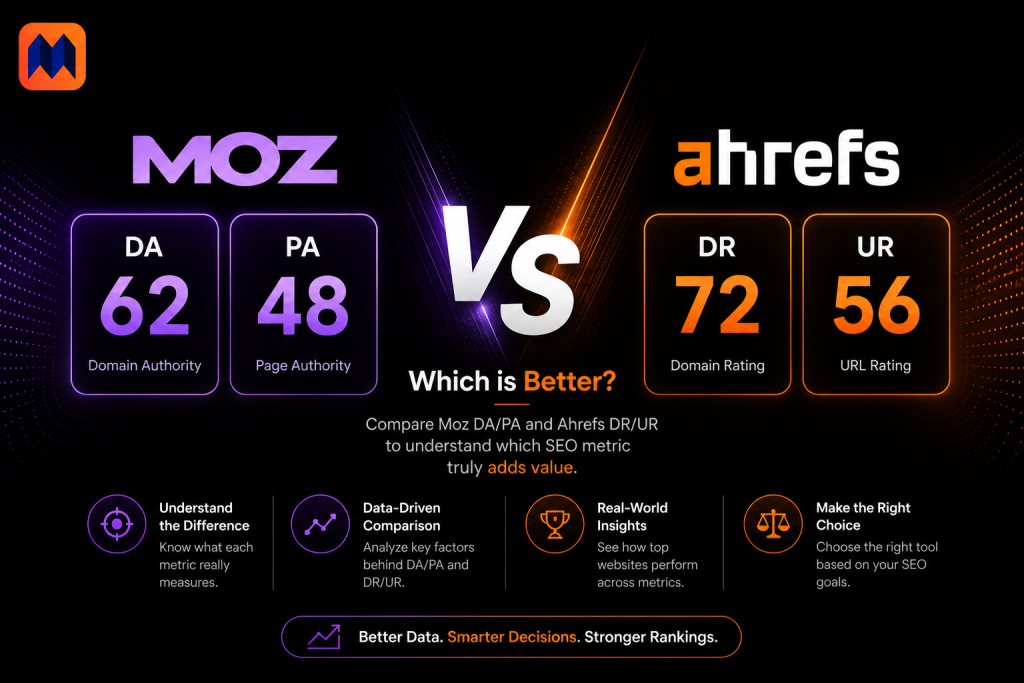
DA, PA, DR, and UR all try to answer the same basic question — how strong is this website? But they’re built on different logic, different data, and with different goals in mind.
Moz Domain Authority (DA)
Moz’s goal with DA was to predict ranking potential. The score runs 1–100 on a logarithmic scale, so moving from DA 70 to 71 takes far more work than moving from 20 to 21.
DA pulls in more than just backlinks. Moz runs the data through a machine learning model trained on real Google SERPs. What goes in: backlink volume, link quality, spam signals, plus factors Moz doesn’t fully disclose.
PA runs the same model at page level instead of domain level. A site at DA 45 might have a homepage at PA 50 and a two-year-old blog post at PA 18. Which number matters depends on exactly what you’re evaluating.
Ahrefs Domain Rating (DR)
Ahrefs built DR to do one thing: measure how strong a site’s backlink profile is. That’s it. No broader ambition.
Traffic, content, spam signals, domain age — none of it factors in. DR is a pure link-graph number, built on the same logic as Google’s original PageRank but applied at domain level. More unique high-authority domains linking to you means a higher DR. Straightforward.
UR does the same at page level. It scores the backlink strength of one specific URL. If you want to know how much link equity a particular page is carrying, UR is the number to look at.
How Each Metric Gets Calculated
This is where the tools genuinely diverge. Once you see how each one calculates, a site showing DA 42 and DR 61 at the same time stops being confusing — both numbers make sense.
How Moz Calculates DA and PA
Moz hasn’t published its full formula. From what’s confirmed: DA grows from the PA model applied at root domain level. PA looks at linking URLs, referring domains, anchor text, link age, and subdomain links.
That data runs through a machine learning model trained on real SERPs. The output tries to reflect how Google weights authority — which is about link quality and context, not just raw count.
Moz’s crawled index held around 44.8 trillion links as of 2025 — bigger than Ahrefs’ 35 trillion. More links in the index generally means broader domain coverage.
How Ahrefs Calculates DR and UR
Ahrefs is open about how DR works. It’s domain-level PageRank. Unique referring domains count more than raw link volume, and link dilution applies — a DR 70 site linking to 5,000 domains passes far less per link than one linking to just 5.
UR follows the same logic one level down. Strong pages linking directly to a URL pushes UR up. Lose those links and it slides back.
A single-signal focus with no hidden variables means DR moves fast. Earn 10 strong backlinks this week and DR could reflect that within a day.
Moz DA / PA vs Ahrefs DR / UR — Full Comparison
Here’s how they compare across the factors that matter for day-to-day SEO decisions:
| Factor | Moz DA / PA | Ahrefs DR / UR |
| Data source | Moz’s own link index (44.8 trillion links) | Ahrefs’ link index (35 trillion links) |
| What it measures | Overall ranking potential — links + multiple signals | Backlink profile strength only |
| Page-level metric | Page Authority (PA) — 1 to 100 | URL Rating (UR) — 1 to 100 |
| Update frequency | Monthly (~once every 30 days) | Every 12–24 hours |
| Spam detection | Yes — Spam Score included | No built-in spam signal |
| Algorithm | Machine learning trained on real SERPs | Domain-level PageRank model |
| Transparency | Less open — factors not fully disclosed | More open — methodology published |
| Manipulability | Harder to fake (multi-factor) | Easier to inflate with bulk links |
| Free access | Yes — MozBar, free checker (3/day) | Limited — Ahrefs Toolbar (paid plan) |
| Price (paid) | From $99/month (Moz Pro) | From $129/month (Ahrefs Starter) |
| Best for | Holistic site comparisons, spam vetting | Link building, fast backlink tracking |
Update frequency is probably the most tangible difference in daily use. Ahrefs refreshes DR every 12–24 hours. Moz updates DA about once a month. Build links this week and only Ahrefs shows you what happened.
Where Moz DA and PA Have the Edge
DA isn’t just DR with a slower clock. It covers ground DR never touches.
Spam Score — DR Has Nothing Like It
Spam Score is the Moz advantage most people undervalue. It flags how closely a domain resembles sites that Google has penalized. Ahrefs has nothing comparable.
During outreach or guest post vetting, Spam Score adds something DR simply can’t — a risk signal. DR 40 with a clean spam score is a different proposition than DR 40 with 75% Spam Score.
Harder to Game
Studies from 2024 and 2025 found DR inflated to 50+ for as little as $15 using link farms. DA is tougher to fake — gaming a multi-factor ML model takes more effort than buying referring domains from one source.
Keep that in mind when buying domains, reviewing link marketplaces, or taking a site’s authority claim at face value.
Free Access Is Genuinely Useful
MozBar, the free DA checker, and Link Explorer’s free tier all give usable data without a subscription. Ahrefs’ free access is thin by comparison, and the toolbar is locked behind a paid plan.
Freelancers, bloggers, and small agencies can cover most daily checks with Moz’s free layer alone.
Where Ahrefs DR and UR Have the Edge
When the work is link-focused, DR is built for it in a way DA simply isn’t.
Update Speed Changes Everything
Monthly DA updates mean you’re always looking at last month’s picture. Build a dozen links in week one and you won’t see anything move until late week four at the earliest.
DR refreshes every 12 hours. During a link-building push, that turns it into a live readout — you can see which links actually moved the score and which didn’t.
Transparent Methodology
Ahrefs publishes its methodology. You know what goes in, how dilution works, and what causes a movement. Moz keeps most DA factors private, which makes diagnosing a score drop harder to explain to a client.
When a client asks why their score dropped, pointing to specific lost referring domains is a cleaner answer than shrugging at an opaque algorithm.
UR vs PA for Page-Level Analysis
PA and UR both measure page-level authority but from different indexes with different update cycles. UR tends to react faster to new links since Ahrefs crawls and updates more often.
If you need to know whether a specific page picked up real link equity after a campaign, UR shows it first.
Which Metric to Use for Each Task
Use both when you can afford the subscriptions. When you have to pick one for a specific job, here’s where each earns its place:
| Task | Use This | Why |
| Guest post outreach | Moz DA + Spam Score | Flags risky domains before you invest time |
| Link building prospecting | Ahrefs DR | Faster updates, cleaner link-strength signal |
| Competitor SERP comparison | Moz DA | Broader signals, closer to ranking potential |
| Monitoring a backlink campaign | Ahrefs DR | 12-hr refresh shows wins faster |
| Vetting a domain for purchase | Both DA + DR | Cross-check both to spot inflated scores |
| Quick free check | Moz DA | Free checker + MozBar, no paid plan needed |
| Page-level link analysis | Both PA + UR | Check the actual page, not just the domain |
The pattern holds throughout. Moz is the call when you need a broader, spam-aware read on a domain. Ahrefs is the call when link strength and freshness are what you’re after. One doesn’t replace the other.
What Neither DA, PA, DR, nor UR Actually Tells You
Most comparison articles stop before getting here. This part matters more than any of the above.
Google doesn’t use DA, DR, or any third-party score in its rankings. John Mueller has said this clearly, repeatedly. Neither metric is a ranking factor. Neither tells you whether a site will outrank you.
What they don’t measure:
• Whether a site’s content matches search intent
• Organic traffic — a DR 60 site with no visitors is a warning sign, not a quality signal
• Content quality, freshness, or topical relevance
• Technical health — speed, crawlability, Core Web Vitals, none of it shows in a score
• Whether a domain ranks for anything competitive
High DA or DR correlates with ranking potential — it doesn’t cause it. Both are useful filters and rough benchmarks. Making either one your primary KPI burns months chasing a proxy while actual ranking factors sit unaddressed.
Scores narrow the field. They don’t close the deal. A DA 28 site pulling 50,000 monthly visitors in your niche beats a DA 55 content farm with no real audience every time.
Can You Trust DA and DR Scores?
Partly. With caveats worth knowing.
Both scores can be faked. DR is the easier target — link farms and bulk referring domain schemes are a documented market. In real tests, DR was pushed past 50 for under $100.
DA takes more effort to game. Inflating a multi-factor ML model across enough dimensions costs more and takes longer than pointing a hundred link farms at a domain.
One thing most people don’t know: neither score drops when Google penalizes a site. Both can stay flat or climb while a site’s traffic collapses to zero. They measure links. Not Google’s trust.
How to protect yourself:
• Cross-check both DA and DR for any high-stakes decision
• Verify organic traffic separately — a high-score site with no traffic almost always bought its way there
•Check Moz’s Spam Score when vetting backlink sources
• Check what the site actually ranks for — real authority shows up in real keyword rankings
Conclusion
No winner. Wrong framing. These tools aren’t competing for the same job.
DR is the sharper tool for link work — fast updates, published math, good for tracking campaigns in real time. DA is broader — slower to move, harder to fake, includes Spam Score, and gives a more rounded picture of ranking potential. PA and UR do the same job at page level, just from different databases at different speeds.
Moz is the pick for domain vetting, spam checks, and free access. Ahrefs is the pick for live link tracking, transparent scoring, and serious backlink research.
Run both when the stakes are high. A site that scores well on one tool and poorly on the other is telling you something. Worth finding out what.
FAQ’s
Is DA or DR more accurate?
Neither is more accurate because they’re not measuring the same thing. DR is more precise as a raw backlink strength score — the formula is published, updates are fast, and the signal is clean. DA is more reliable as a holistic ranking potential estimate because it pulls in more dimensions. Use DR when you want a link-graph number. Use DA when you want a broader authority read.
Why does a site have high DR but low DA, or vice versa?
Different formulas produce different numbers. A site with lots of high-DR referring domains gets a strong DR but might still trigger Moz’s spam filters or lack the broader signals DA requires. Flip it around — a site with older, diverse, clean links can score better on DA’s multi-signal model than on Ahrefs’ link-only calculation.
Do I need to pay for both Moz and Ahrefs?
Not if budget is the constraint. Moz’s free tools handle basic DA and PA checking without a subscription. Ahrefs needs a paid plan for anything meaningful. Start with Moz free for daily outreach checks. Bring in Ahrefs when you’re running active link campaigns and need fast DR feedback.
Which metric do most SEO professionals prefer?
Around 44% of SEO professionals call Ahrefs DR their primary metric, mainly because of its transparency and speed. DA is still widely used, especially at agencies that rely on Moz’s broader suite and Spam Score data. Most practitioners who’ve been doing this long enough just use both for different tasks.
Does a high DA or DR guarantee better Google rankings?
No. Google has confirmed it doesn’t factor in third-party scores. DA and DR correlate with rankings because authoritative sites tend to rank — not because Google reads these numbers. A DA 15 site outranks a DA 50 site all the time when the content is more relevant. Chase real ranking factors, not proxy scores.
How often should I check DA and DR for my site?
DA: monthly. Moz only updates it monthly anyway, so checking more often is just noise. DR: weekly or daily when you’re mid-campaign — the 12-hour refresh makes that actually useful. For general monitoring with nothing active happening, quarterly reviews of both catch meaningful trends without turning into metric-watching.
Can I use DA and DR to evaluate backlink sources?
Yes, but treat them as the first pass, not the final answer. DA 35 with low Spam Score is a different prospect from DA 35 with 80% Spam Score. And DR 50 with zero organic traffic is almost always a bought-link situation. Open the site, read the content, check what it actually ranks for. Scores narrow the list. You still have to look.

Writes about SEO, link building and domain authority.