
You landed a mention on a high-DA site. Big publication, real audience, your link is right there in the article. Then you check the source code and see rel=”nofollow.”
Suddenly the win feels like a loss. You wonder whether that link just did nothing for your DA.
The real answer is layered. This guide covers exactly how nofollow links interact with Moz’s DA calculation, what Google changed in 2019 that most people still haven’t fully processed, and why nofollow links matter more than a flat “no” suggests.
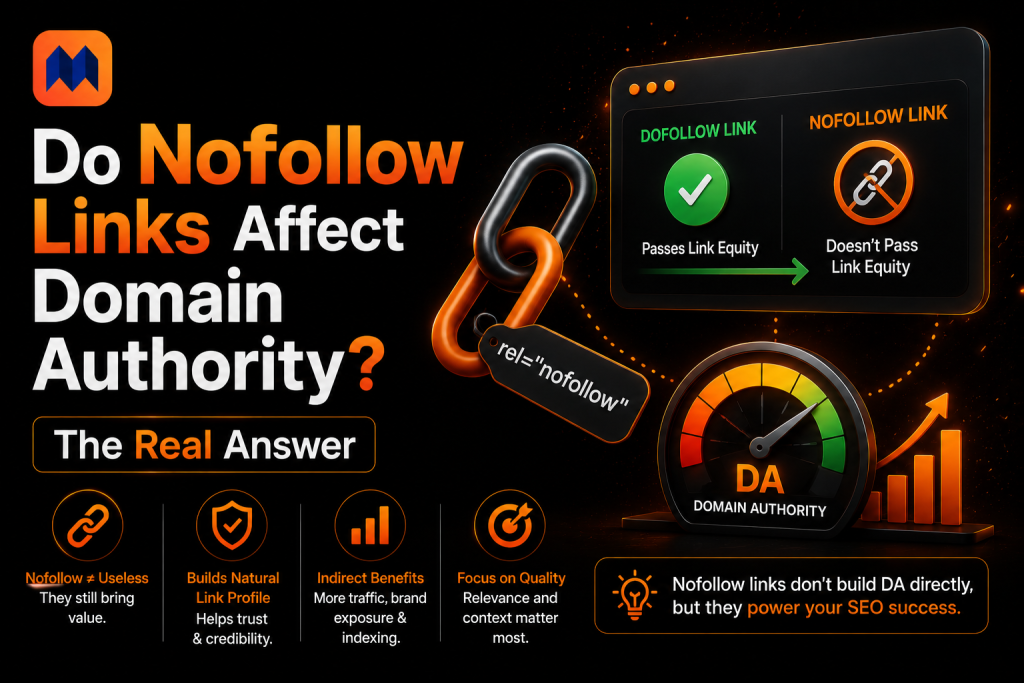
The Short Answer: No Direct DA Impact, But Not Zero Value
Moz calculates Domain Authority using dofollow links. Nofollow links are not counted in DA or Page Authority calculations. That part is simple and confirmed.
But “not counted in DA” and “worthless” are two different things. A nofollow link from Forbes drives real traffic to your site. That traffic can lead to someone else linking to you with a dofollow. The nofollow created the chain reaction that eventually moved your DA.
Nofollow links affect DA indirectly, through referral traffic, brand exposure, and the dofollow links they often trigger. They don’t plug directly into Moz’s calculation, but they can set off events that do.
The more nuanced point — the one most guides miss — is what Google changed in September 2019. Since March 2020, Google treats nofollow as a hint rather than a strict directive. It may choose to follow, crawl, or even count a nofollow link for ranking purposes in certain cases. This doesn’t change how Moz calculates DA, but it changes how seriously you should dismiss nofollow links from your overall SEO strategy.
What Nofollow Links Actually Are — And What Changed in 2019
Google introduced the rel=”nofollow” attribute in 2005 to fight blog comment spam. The idea was straightforward: add this tag to a link and tell Google not to count it as an endorsement or pass any ranking credit.
For 14 years, that’s exactly how it worked. A nofollow link carried no link equity. Google’s crawler would see the tag and stop. Done.
In September 2019, Google shifted the entire model. Nofollow — along with two new attributes, rel=”sponsored” and rel=”ugc” — became hints rather than directives. Google’s exact words from its official announcement: “When nofollow was introduced, Google would not count any link marked this way as a signal to use within our search algorithms. This has now changed.”
What changed in practice:
- Google may now crawl nofollow links for discovery and indexing purposes
- Google may use nofollow links as ranking signals in some cases, at its own discretion
- The three attributes — nofollow, sponsored, ugc — all function as hints Google can act on or ignore
Google also clarified that for the vast majority of nofollow links, nothing changed in practice. Most won’t influence rankings. But the shift from “ignore completely” to “consider as a hint” opened a door that was previously sealed shut.
All Four Link Attributes Explained
Here’s a clean reference for how each link attribute works, when it was introduced, and what it signals:
| Attribute | Introduced | SEO Value | When to Use |
| rel=”dofollow” | Default (no tag needed) | Full link equity passed | Editorial links, organic mentions |
| rel=”nofollow” | Since 2005 | No equity — hint to Google since March 2020 | Comment links, untrusted sources |
| rel=”sponsored” | Since Sept 2019 | No equity — flags paid content for Google | Paid posts, affiliate links, ads |
| rel=”ugc” | Since Sept 2019 | No equity — marks user-generated content | Forum posts, blog comments, reviews |
The sponsored and ugc attributes matter from a compliance standpoint. Marking a paid link as a regular dofollow can trigger a Google manual action. Not because the link itself is harmful, but because the lack of disclosure violates Google’s link spam policies.
If you’re paying for links, guest posts, or affiliate placements, always mark them with rel=”sponsored.” Failing to do so risks a penalty that costs far more than any DA gain those links might have produced.
Dofollow vs Nofollow — Full Comparison for DA and SEO
Here’s exactly how the two link types compare across every factor that matters for DA and overall SEO:
| Factor | Dofollow Links | Nofollow Links |
| Passes link equity (PageRank) | Yes — full authority transfer | No — by design (though Google may use as hint) |
| Directly boosts DA | Yes — core input in Moz’s model | No — Moz doesn’t count nofollow in DA calculation |
| Drives referral traffic | Yes, if the page gets visitors | Yes — users still click and arrive at your site |
| Helps Google crawl your site | Yes | Possible — Google may crawl nofollow links since 2020 |
| Builds brand visibility | Yes | Yes — equally visible to human readers |
| Indirectly boosts DA | Yes (via traffic signals) | Possible — traffic can lead to dofollow links |
| Risks from spam sources | High — toxic dofollow links hurt DA | Low — nofollow links rarely damage your profile |
| Natural link profile signal | Needed for link equity | Needed for profile diversity and naturalness |
The naturalness row is the one most people overlook. A backlink profile with 100% dofollow links is a red flag to both Moz and Google. Real sites accumulate nofollow links naturally — from Wikipedia, news sites, social media, and comment sections. If every single link to your site passes equity, it looks manufactured.
A healthy mix of dofollow and nofollow links signals organic link acquisition. Aiming for only dofollow links is both unrealistic and counterproductive.
How Nofollow Links Can Indirectly Push Your DA Up
The indirect path from nofollow link to higher DA runs through referral traffic, and it’s more reliable than most people think.
Step 1: A High-DA Site Links to You (Nofollow)
A popular industry publication cites your original research with a nofollow link. The link passes no direct equity to your DA. But the article gets 50,000 monthly readers.
Step 2: Real Traffic Arrives at Your Site
Even 200 of those readers click through to your site. They explore your content, spend time reading, and find it genuinely useful. Some bookmark it. Some share it on their own platforms.
Step 3: Dofollow Links Follow
Among those 200 visitors, three are bloggers in your niche. They cite your research in their own articles — with dofollow links. Those three links feed directly into your DA calculation.
The nofollow started the chain. The dofollow links finished it. This pattern is how nofollow links from authoritative sources reliably produce downstream DA growth, even though they contribute nothing directly to the Moz calculation.
Brand Mentions Without Links
A variation on this: a high-DA site mentions your brand by name without linking at all. Readers search for you directly. Some find your site, like your content, and link to it from their own properties. The “link” that started the chain wasn’t even a link — it was a brand mention. Nofollow links function similarly.
When Nofollow Links Genuinely Don’t Help
Nofollow links have real value from the right sources. From the wrong ones, they’re just noise — and occasionally a warning sign.
Nofollow Links From Low-Traffic Sites
The indirect DA benefit depends on referral traffic. A nofollow link from a DA 40 site with 200 monthly organic visitors sends almost nobody to your site. The brand exposure is minimal. The downstream dofollow probability is near zero. This type of nofollow link is harmless but genuinely adds nothing to your SEO.
Mass Nofollow Links From Spam Sources
Nofollow links from spam directories, comment farms, or link schemes don’t damage DA directly — because Moz doesn’t count them. But they can raise your Spam Score if many of them come from high-Spam Score domains.
A rising Spam Score negatively affects DA. So indirectly, a large volume of nofollow links from toxic sources can still hurt you. This is rare, but worth watching in your monthly backlink audit.
Forum and Comment Nofollow Links
WordPress and most forum platforms automatically nofollow all comment links. These exist to protect site owners from spam, not to devalue legitimate contributions. A thoughtful comment on a high-traffic forum drives real referral traffic even if it passes zero equity. Don’t ignore this channel just because the link is nofollow.
Practical Strategy: How to Handle Nofollow Links in Your SEO
Understanding nofollow links properly changes how you approach link building outreach and backlink auditing.
Don’t Reject Nofollow Opportunities From High-Traffic Sites
A nofollow link in a Forbes article, a Wikipedia citation, or a major industry newsletter is not a failed link building outcome. The traffic value, brand association, and downstream dofollow potential make these links genuinely worth pursuing. Don’t turn down a high-DA nofollow placement in favor of a lower-DA dofollow from a site nobody reads.
Track Your Nofollow to Dofollow Conversion Rate
Keep a note of which nofollow placements sent traffic spikes. Cross-reference those traffic events against new dofollow backlinks acquired in the following 30–60 days. Over time, you’ll see which types of nofollow placements convert into dofollow links from downstream publishers — and prioritize those channels.
Use a DA PA Checker to Audit Your Full Profile Mix
When running a bulk DA PA check on your backlinks, filter by dofollow vs nofollow. You want to see your dofollow count growing month over month. Nofollow count can grow too — that’s healthy and natural. The number to watch is quality backlinks (dofollow only), since that’s the count that feeds directly into DA.
A stagnant dofollow count with a rising nofollow count means your link building is generating mentions but not equity. Useful information for adjusting your outreach strategy toward sites more likely to link without the nofollow tag.
Don’t Disavow Nofollow Links Unless They’re Truly Toxic
Some people disavow nofollow links because they come from low-DA sites. This is almost always unnecessary. Nofollow links don’t damage your DA directly. Unless the linking domain has an extremely high Spam Score and is clearly part of a spam network, leave nofollow links alone. Disavowing them gains nothing and costs the time it takes to review and file the disavowal.
Conclusion on Do Nofollow Links Affect Domain Authority
Nofollow links don’t directly feed into DA. Moz is clear on that. But writing them off entirely misses how authority actually builds over time.
A nofollow link from a site with a large, engaged audience drives real visitors to your content. Some of those visitors become dofollow linkers. The DA growth you attribute to your outreach often traces back through a nofollow placement that started the chain.
Focus your link building on dofollow links from high-DA, high-traffic sources. Don’t turn down nofollow placements from authoritative publishers just because of the tag. And keep your profile natural — a mix of both link types is what a real, growing website looks like.
Read more : Da Pa Checker
Frequently Asked Questions
Do nofollow links count toward Moz Domain Authority?
No. Moz’s DA calculation is built around dofollow links. Nofollow links are not included in the metric. This is confirmed by Moz’s own documentation. However, nofollow links can indirectly influence DA through referral traffic and brand exposure that triggers dofollow links from other publishers. The direct answer is no. The practical impact is more nuanced than that.
Did Google’s 2019 nofollow change affect DA?
Not directly. Google’s 2019 announcement changed how Google itself processes nofollow links — treating them as hints rather than hard directives. But Moz sets its own rules for DA, and those rules still exclude nofollow links from the calculation. The 2019 change matters for Google rankings and crawl behavior, not for the Moz DA score specifically.
Should I pursue nofollow links in my link building strategy?
Yes, selectively. Nofollow links from high-traffic, high-DA sites produce real referral traffic and brand credibility that often translate into dofollow links from downstream publishers. A nofollow link from a major industry site is more valuable than a dofollow link from a low-traffic blog nobody reads. Filter by traffic potential and audience alignment, not just by link attribute.
Can nofollow links raise my Spam Score?
In rare cases, yes. A large volume of nofollow links from high-Spam Score domains can contribute to Spam Score even if those links don’t feed into DA directly. Moz’s Spam Score algorithm looks at patterns in your full backlink profile, not only dofollow links. A sudden spike in nofollow links from spam directories or toxic networks is worth auditing, though it rarely requires disavowal.
What is the difference between rel=nofollow, rel=sponsored, and rel=ugc?
All three tell Google not to count the link as a standard editorial endorsement. Nofollow is the original catch-all. Sponsored marks paid links, ads, and affiliate placements — failing to use it on commercial links risks a manual penalty. UGC marks user-generated content like forum posts and blog comments. Since March 2020, all three function as hints that Google can act on or ignore at its own discretion.
Will a 100% dofollow backlink profile hurt my DA or rankings?
It signals artificial link building. Real sites accumulate a mix of dofollow and nofollow links naturally over time. If every single backlink to your domain passes equity, both Moz and Google treat that as a potential red flag for link scheme activity. A natural profile includes nofollow links from social media, news sites, Wikipedia, forums, and comment sections. Trying to achieve 100% dofollow is both unrealistic and counterproductive.

Writes about SEO, link building and domain authority.