
You followed the tutorials. You got backlinks. You published content regularly.
Yet the rankings barely moved. And nobody told you why.
Three numbers tend to explain most of it: DA PA, and Spam Score. Most people look them up without knowing what they mean.
This guide covers all three in plain language — what they mean, how to check them, and how to use the data.
What Is Domain Authority (DA) and Why Does It Matter?
Moz built Domain Authority to judge how competitive a site looks in search. The score that runs 1 to 100 — higher is stronger, though the real value comes from comparison, not the raw number itself.
Fresh domains usually land at DA 1. Big sites like Wikipedia push close to 100. Most real-world niche sites sit somewhere in the 20–60 range, which is a wide middle ground.
Moz figures out DA by weighing a few things:
- How many different websites are linking to you (not just total links — unique domains)
- The strength of those linking sites — a link from Forbes counts for more than one from a random blog
- Your overall backlink profile taken as a whole
Worth saying plainly: Google does not use DA. Moz built it as a comparison tool — to help you gauge where you stand against competitors, not to tell you where you’ll rank.
Stop fixating on a target number. What matters is whether your profile is stronger than the sites you’re trying to beat.
What Is Page Authority (PA) and How Is It Different?
PA works on the same 1–100 scale as DA, but instead of scoring the whole domain, it scores one specific page.
Your homepage might sit at PA 45 while a blog post from two years back is at PA 22. Every page builds its own score depending on what links are pointing to it directly.
During outreach, PA matters more than DA. Check the PA on the exact page you want the link from, not just the site’s overall domain score.
You’ll often find sites with average DA that have one or two pages with surprisingly high PA. Usually that means one article went viral or picked up a bunch of good links while the rest of the site stayed quiet.
What Is Spam Score and What Does It Actually Tell You?
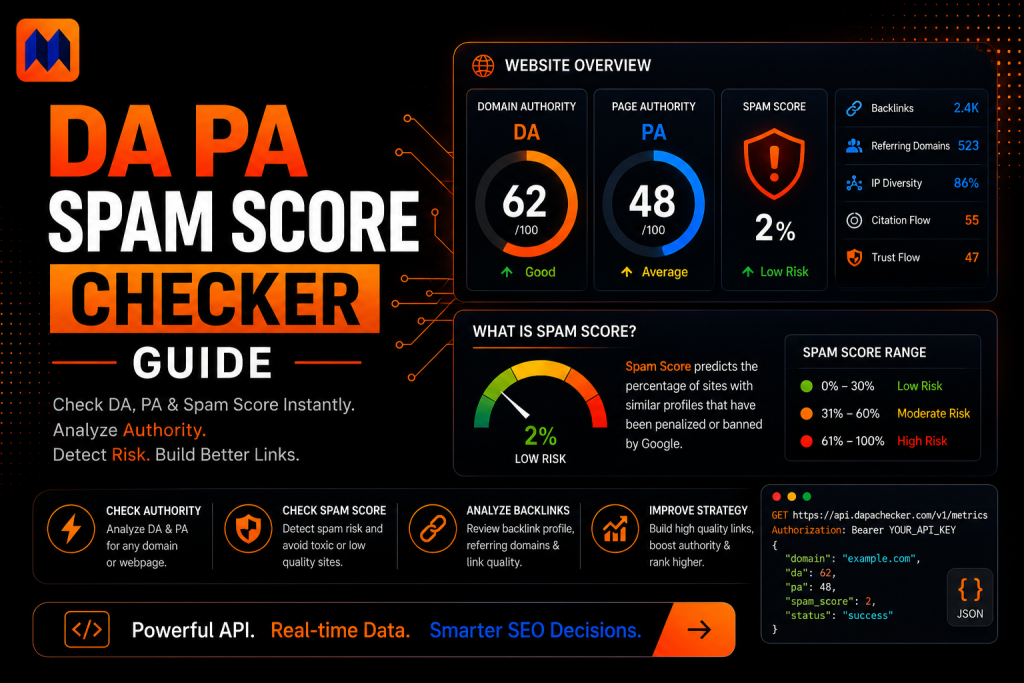
Spam Score trips people up more than any other metric. It’s a percentage from 0 to 100 showing how similar a domain looks to sites Google has penalized or removed from its index.
Moz identified 27 patterns that show up repeatedly on penalized sites and built a scoring model around them. More matching patterns — higher score.
The thing most people miss: Spam Score flags risk, not confirmed guilt.
A 70% Spam Score doesn’t mean a site is guilty of anything. It shares some surface-level traits with penalized sites. That’s it. Look at the actual site before making a call.
The risk ranges break down like this:
| Spam Score Range | Risk Level | Action |
| 0% – 30% | Low Risk | Safe to use |
| 31% – 60% | Medium Risk | Review manually |
| 61% – 100% | High Risk | Investigate further |
Say you spot a backlink from a domain with 72% Spam Score. Don’t rush to disavow it. Pull the site up in a browser. Read a few pages. Check who’s linking to it. New sites, thin blogs, and weirdly-structured domains can trigger high scores without doing anything harmful.
How to Use a DA PA Spam Score Checker
Running a check is simple once you’ve done it once.
Step 1 — Enter Your URLs
Paste the domains you want to check, one per line. Bulk checkers handle anywhere from 5 to 1,000 URLs depending on the tool you pick.
Step 2 — Run the Check
Hit the button and wait. The tool pings Moz’s database and pulls the data. Larger batches take longer but usually finish within a minute.
Step 3 — Read the Results Table
Results show up in a table: DA, PA, Spam Score, total backlinks, and sometimes dofollow counts. Scan down the list and patterns jump out fast.
Step 4 — Export for Reporting
Download the results as a CSV. Useful for client reports, keeping historical records, or comparing numbers month after month.
One thing worth knowing: some tools run on Moz’s free API, which can return stale or rounded data. Tools using the paid API pull fresher numbers. It matters when you’re making real decisions based on those scores.
Best Tools to Check DA, PA, and Spam Score
There’s no shortage of options. Here’s what’s actually worth your time:
Moz Link Explorer
Moz built these metrics, so this is always the most accurate source. Free accounts get 10 lookups a month. If you need bulk checking or full backlink data, a paid plan is the only way in.
Bulk DA PA Checker Tools (Third-Party)
Sites like dapachecker.org and similar platforms let you check multiple URLs at once — sometimes up to 5 or 10 at a time for free. These use Moz’s API, so the data is reliable. Good for quick checks without a subscription.
Ahrefs and SEMrush
Neither uses Moz data. Ahrefs has Domain Rating (DR), SEMrush has Authority Score — different formulas, different outputs. Both are solid for backlink research, but don’t mix their scores with DA or PA numbers.
SEO Review Tools / PrepostSEO
Solid free options for one-off checks. Nothing fancy, but the data holds up for basic research.
For casual use, any free checker does the job. If you’re running audits across dozens of client sites every month, Moz’s paid access is the smarter call.
How to Interpret DA, PA and Spam Score Together
None of these numbers means much on its own. You need all three to get a real read on a domain.
When you’re evaluating a site as a link prospect, here’s a quick framework:
DA above 30 + PA above 20 + Spam Score below 30%
Good to go. The site has earned its authority, the page carries its own weight, and nothing looks risky. Worth pursuing.
DA above 30 + Spam Score above 60%
Slow down here. Sites that bought links aggressively or changed hands a few times often land in this range. Pull the site up, look at who’s linking it, read some content, then decide.
DA below 20 + Spam Score below 20%
Young sites look like this. Low DA on its own means nothing bad — if the niche lines up and Spam Score is clean, even a newer domain can pass solid link value.
Low DA + High Spam Score
Hard pass. This combo actually signals real risk. Move on.
How to Improve Your DA and PA Over Time
Don’t expect overnight results with either metric. Both move slowly and reward patience over shortcuts.
- Build links from high-DA, low-spam domains — One backlink from a trusted DA 50 site outweighs 50 links from DA 10 sites. Focus on quality over volume.
- Earn links to specific pages, not just your homepage — This directly improves individual PA scores. Guest posts, resource link building, and digital PR all work well for this.
- Remove or disavow toxic backlinks — If you’re inheriting backlinks with very high Spam Scores, use Google’s Disavow Tool to signal that you don’t endorse those links.
- Grow your referring domain count — The more unique, legitimate domains link to you, the stronger your DA climbs. Diversification matters more than raw backlink count.
- Publish content worth linking to — Data studies, original research, and detailed guides attract natural backlinks. This is the slowest approach — and also the most sustainable one.
Common Mistakes People Make with These Metrics
Mistake 1 — Treating DA as a Google Ranking Factor
Google never touches DA. If you’re grinding for a higher score while ignoring whether your links are actually any good, you’re doing it backwards.
Mistake 2 — Rejecting Every High Spam Score Domain
A 65% score doesn’t make a site guilty. Plenty of clean sites trigger high scores for reasons that have nothing to do with spam. Look before you disavow.
Mistake 3 — Checking DA Once and Never Revisiting
Moz updates its model regularly, and your DA can drop without you doing a single thing wrong. A competitor picked up new links? Your score might slip. Check it a few times a year at minimum.
Mistake 4 — Using DA as the Only Link Quality Signal
DA says nothing about traffic, content quality, or genuine authority. A DA 60 content mill is a far worse link than a DA 25 niche site with an engaged audience who reads the content.
Conclusion
Once you stop treating these numbers like gospel and start using them as pointers, they get a lot less confusing.
DA shows domain-level strength. PA shows individual page strength. Spam Score tells you how risky a domain looks based on the patterns Moz links to penalized sites.
Use all three when sizing up a potential link source. Track your own numbers over time. A backlink profile built on real relationships and solid content beats one built around gaming scores every time.
Pick a checker you trust, audit your backlinks a few times a year, and build the kind of links you’d be proud to have. That’s the strategy — and it’s simpler than most making it sound.
What is a good DA score for a website?
It depends entirely on your niche. If the sites ranking above you sit at DA 25–40, then DA 32 is competitive. If you’re up against DA 70+ domains, you have more work ahead. Always compare against your actual competition, not some abstract benchmark.
Does a high Spam Score mean my site is penalized?
Nope. High Spam Score means your site shares some surface traits with penalized sites — nothing more. Google ignores this metric entirely. Use it as a trigger to audit your links, not proof something is broken.
How often does Moz update DA and Spam Score?
About once a month, give or take. Links you built last week probably won’t move the needle for a few more weeks. This is a slow-moving metric — don’t watch it daily.
Can I improve my DA quickly?
Short answer: no. DA is deliberately slow-moving. A strong month of link building might not show up for 6–8 weeks. If someone’s promising you rapid DA growth, walk away.
What's the difference between DA and Ahrefs DR?
Similar concept, completely different methodology. A DA 40 site might show DR 55 in Ahrefs — both numbers can be accurate. They just index the web differently. Pick one metric and track it consistently so your comparisons mean something.
Should I disavow all backlinks with high Spam Scores?
Not without checking them first. Bulk disavowing is one of the easiest ways to accidentally hurt yourself — you might remove links that were helping. Go through them individually and only disavow what’s clearly junk or manipulative.
Is it worth paying for a DA PA checker tool?
For checking your own site or vetting a few prospects, free tools are more than enough. If you’re running weekly audits on 50+ client domains, that’s when a Moz subscription starts paying for itself.

Writes about SEO, link building and domain authority.