
You open a DA checker and see your score sitting at 16. Then you look up your top competitor — a national chain — and see 74 staring back. That gap looks like a wall. How is a small plumbing company in Phoenix supposed to compete with a brand that’s been building links for over a decade?
Better than you’d expect, actually. DA and PA play a very different role in local SEO compared to national organic search. When you’re targeting a specific city or neighborhood, that gap in your score rarely matters as much as it looks — and fixating on it tends to pull focus away from the signals that actually drive local rankings.
This breaks down what DA and PA genuinely do in local search, which benchmarks make sense for small businesses, and where your time is better spent.
What DA and PA Actually Are (and What They’re Not)
Domain Authority (DA) is a Moz-created score that runs from 1 to 100. It estimates how likely your site is to rank in search results, based mostly on your backlink data — the number of referring domains pointing to you, how trustworthy they are, and how much link equity flows into your root domain. Higher scores suggest stronger ranking potential, in theory.
Page Authority (PA) applies the same logic to a single URL rather than the whole domain. Your homepage might sit at PA 35 while your ‘Emergency Plumber Phoenix’ service page sits at 18 — two very different starting points for the pages that matter most to your business.
Here’s what both metrics are not: Google ranking factors. Google has said this directly, in its own documentation — Moz’s DA and PA scores aren’t used in its algorithm. These are third-party approximations, not signals Google reads.
What they do capture is a reasonable approximation of the signals Google actually weighs: backlink quality, referring domain diversity, link relevance, and overall site trust. A DA 55 site almost always has a stronger link profile than a DA 15 site — and that link profile does influence rankings. The score is a proxy; the links behind it are what actually count.
For small businesses, that distinction matters. You don’t need to chase a DA number. You need to build the links that move both the number and your actual rankings.
Do DA and PA Directly Affect Local Search Rankings?
For local search specifically — the 3-pack, Google Maps results, and “near me” queries — DA and PA are contributors but not the dominant signals.
A 2025 study by Search Atlas analyzing local ranking factors found that Domain Power (their equivalent of domain authority) accounts for roughly 5.9% of local pack rankings. By comparison, proximity to the searcher, review signals, and Google Business Profile completeness carry significantly more weight.
BrightLocal’s annual Local Search Ranking Factors study backs this up. On-page factors — which correlate closely with DA and technical SEO strength — have actually declined in relative importance since 2023 as Google places more weight on real-world engagement signals: reviews, GBP activity, photo uploads, and booking interactions.
That doesn’t mean DA is irrelevant. It means it’s one signal in a stack of signals — and for local queries, it’s not at the top of that stack.
Where DA and PA matter most for local businesses is in organic results beneath the local pack. When someone scrolls past the map and the 3-pack listings, the blue organic links they see are heavily influenced by domain and page authority. A local business competing for those organic positions needs real link authority to show up there. The local pack and organic results are two separate competitions, and DA affects them differently.
Why a DA 30 Small Business Can Beat a DA 70 National Brand Locally
This is the part most DA explainers miss entirely. Local SEO has a leveling effect that national organic search doesn’t.
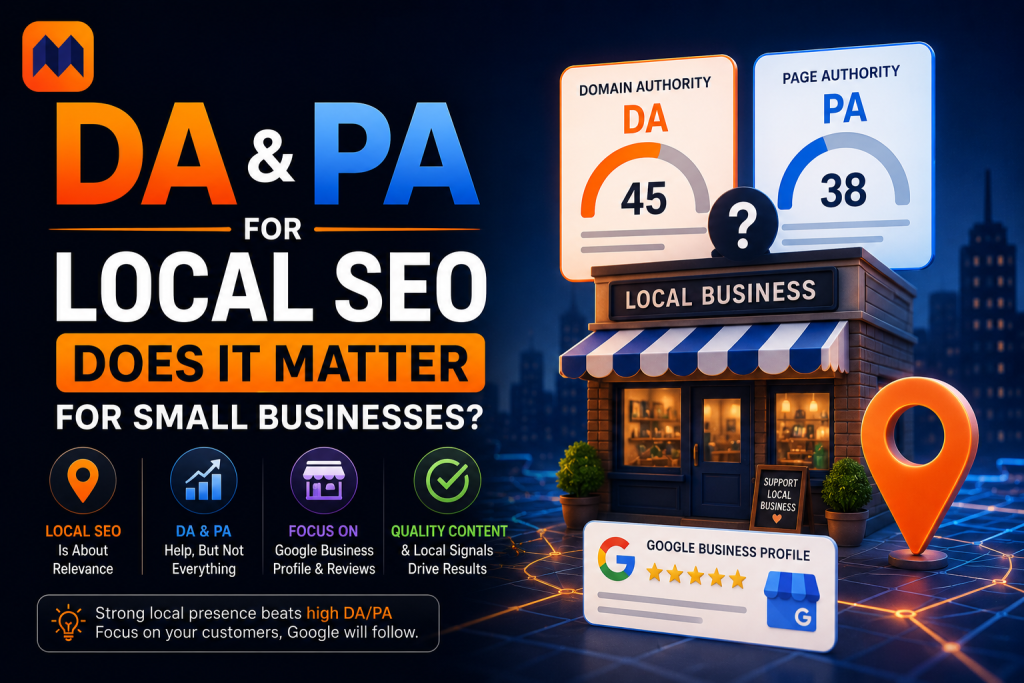
Google’s local algorithm treats proximity, local relevance, and engagement signals as their own category — separate from raw domain authority. A national chain with DA 70 and no physical location in your city, no local citations, and zero reviews mentioning your neighborhood can lose to a local competitor with DA 30 that has 200 Google reviews, an active GBP, and solid NAP citations across local directories.
The compareseo.net benchmark data makes this concrete: even a DA 30 can dominate local SERPs when competitors are hovering at DA 15–20. The competitive threshold shifts based on who you’re actually competing against — not the national landscape.
A roofing company in Tulsa isn’t competing with a DA 80 home improvement platform for ‘roof repair Tulsa.’ The real competition is three or four other local roofers, most sitting somewhere in the DA 15–35 range. A DA 30 site with strong local signals wins that fight — not because 30 is a great number universally, but because it’s strong enough given who’s actually in the arena.
That’s why the question worth asking isn’t ‘is my DA good?’ — it’s ‘is my DA good compared to my actual local competitors?’ Pull their scores. That gap tells you far more than your raw number does.
What Matters More Than DA for Local SEO
When you’re competing for local search, these factors carry more weight than DA or PA — and deserve your attention first:
Google Business Profile completeness and activity. In 2025, Google introduced “Popularity” as a primary local ranking factor — measuring real-world user engagement with your GBP. Businesses that regularly upload photos, post updates, respond to reviews, and earn direct interactions (calls, direction requests, website clicks) through GBP outrank businesses with stronger backlink profiles that have stagnant profiles. An optimized, active GBP is worth more in local results than a 10-point DA improvement.
Review volume and recency. Google treats reviews as direct trust signals. In practice, 250 reviews at a 4.6 average consistently beats a competitor with 20 reviews and a DA 15 points higher — especially in local pack results. Review count, recency, and the keywords appearing in review text all feed local ranking signals.
NAP consistency across citations. Your name, address, and phone number need to be identical everywhere — your website, GBP, Yelp, Bing Places, Apple Maps, and every directory you’re listed on. Conflicting NAP data across sources confuses Google’s local index and erodes local authority. None of that shows up in a DA score, but it directly shapes where you appear in results.
Localized on-page signals. Service pages with city-specific content, embedded Google Maps, locally relevant schema markup, and location-based internal linking all strengthen local relevance signals that DA doesn’t measure at all.
These signals don’t replace the need for domain authority — they work alongside it. But for a small business with limited time and budget, a stagnant GBP and 12 reviews will cost you more local rankings than a DA of 22.
The DA Benchmarks That Actually Mean Something for Local Businesses
Forget searching for a universally ‘good’ DA number. The targ
| Business Type | Typical Local Competitor DA Range | Competitive Target DA |
| Single-location service (plumber, electrician, cleaner) | DA 10–25 | DA 25–35 |
| Local restaurant or café | DA 15–30 | DA 30–40 |
| Local law firm or medical practice | DA 20–40 | DA 35–50 |
| Local e-commerce (city-specific retail) | DA 20–35 | DA 35–50 |
| Local franchise competing with national chains | DA 25–40 | DA 40–55 |
Take the table as a starting point, not a rulebook. Before committing to any DA target, pull up the top 5 businesses ranking for your core local keyword and check their actual DA scores. Aim to reach or beat the highest one. That’s the number worth building toward.
At the page level, PA on your core service pages matters more than your overall DA for the specific queries those pages target. A plumber’s “Emergency Plumber Chicago” page with a PA of 35 can outrank a higher-DA competitor whose service page has a PA of 18 — especially when paired with strong local signals
How to Build DA as a Small Local Business
Building DA as a local business is more accessible than most people assume. You don’t need a content team, a PR agency, or cold outreach to national publications. Small businesses have link opportunities that large national brands can’t access.
Local business citations. Start with GBP, Yelp, Bing Places, Apple Maps, and the BBB, then move into niche directories — Angi for home services, Houzz for interior design, Avvo for legal. These aren’t high-DA links, but they’re locally relevant, and Moz’s algorithm weights local relevance as a real signal.
Local press and community features. Your city newspaper, neighborhood blogs, community event sites, and Chamber of Commerce all regularly feature local businesses and link to them. A quote in a local story or a Chamber directory listing earns you an editorial backlink that carries genuine trust with both Google and local readers.
Partner and vendor links. If you work with local suppliers, wholesalers, or business partners, ask about a reciprocal link or a “trusted partner” mention on their website. These links are locally relevant and genuinely earned.
Local sponsorships. Put a few hundred dollars into sponsoring a youth sports team, a community charity event, or a neighborhood organization. Most will add your business to their website’s sponsors page and link back to you. It’s one of the simplest legitimate link-building moves a local business can make.
Hyperlocal content that earns links. Write content specifically about your city that local journalists and bloggers naturally want to cite: ‘Denver’s Top 10 Potholes by Neighborhood’ for an auto shop, or ‘What Phoenix’s Extreme Summers Do to Home Plumbing’ for a plumber. Local outlets reference locally specific data. National brands never compete in this space.
Page Authority and Local SEO — The Overlooked Half
Page authority gets almost no attention in small business SEO discussions, and that’s a real gap.
For local businesses, PA on your key service and location pages directly influences which pages rank for city + service queries. A homepage with PA 30 doesn’t help much when your ‘HVAC Repair Dallas’ service page is sitting at PA 12 — that page competes at a disadvantage no matter how strong your overall domain looks.
Build PA on your highest-value local pages by:
- Internal linking from your blog and other strong pages to service pages using anchor text that includes city + service keywords
- Building links directly to service pages using the citation and partnership tactics above — not pointing everything at your homepage.
- Publishing supporting content — city guides, FAQ pages, comparison posts — that links internally to your core service pages and channels link equity toward the URLs you actually need to rank.
A solid internal linking setup can move a service page’s PA by 8–12 points without touching your off-page link building at all. For local businesses working with limited time and budget, that’s a meaningful return for a low-cost effort.
Common DA/PA Mistakes Small Businesses Make
Treating DA as a goal instead of a signal. DA measures what you’ve already built — it’s not the thing you’re actually building. When people chase a DA number, they end up buying links or joining link schemes that create more problems than they solve. Build real local links and citations and the score takes care of itself.
Ignoring competitor DA context. A DA of 22 looks weak against a national benchmark. Against five local competitors at DA 12–18, it’s dominant. Check your local competitive landscape before concluding your DA is a problem.
Building domain-level links only. If every backlink points to your homepage, your service pages stay weak. Distribute link acquisition across your highest-value local service pages to build PA where it actually affects rankings.
Obsessing over DA while neglecting GBP. Someone who spends six months chasing backlinks to nudge from DA 18 to DA 24 — while their GBP sits without photos and 40 reviews go unanswered — will lose to the competitor at DA 16 who has 180 reviews and a fully active profile. Local SEO rewards signals searchers actually see. DA isn’t one of them.
Conclusion on DA PA for Local SEO
DA and PA for local SEO matter — but they’re not the whole game, and for most small businesses, they’re not even the most important part. Your Google Business Profile, your reviews, your citations, and the quality of your local service pages move local rankings faster than chasing a DA number.
Know your local competitive DA benchmark. Build links that are locally relevant and genuinely earned. Use PA strategically on the service pages that matter most. And don’t let a gap on a third-party dashboard convince you that a national competitor wi
Frequently Asked Questions
Does Google use DA or PA as a ranking factor?
No. Google has stated directly that neither Moz’s DA nor PA is used in its ranking system. They’re third-party approximations of the signals Google weighs — backlink quality, referring domain count, and overall site trust. Useful as benchmarking tools, but not ranking inputs Google actually reads.
What is a good DA score for a local small business?
It depends entirely on your local competition. Pull the DA scores of the top 5 businesses ranking for your primary local keyword and set your target at or above the highest one. As a general guide, DA 25–35 is often competitive for single-location service businesses, while local law firms, medical practices, and businesses competing against franchises typically need DA 40–50 to be consistently competitive in organic results beneath the local pack.
Can a small business with low DA rank in the Google local pack?
Yes — it happens regularly. The local pack ranks on proximity, reviews, GBP completeness, and citation consistency far more than on raw domain authority. A business at DA 20 with 200 reviews, a complete GBP, and consistent NAP data across directories will outrank a DA 50 competitor whose profile is stagnant. Low DA hurts most in the organic results below the pack — not the pack itself.
How long does it take to build DA for a local business?
With consistent citation building, local press mentions, and partnership links, most small businesses can move from DA 10–15 to DA 25–35 within 6 to 12 months. DA growth is logarithmic — the lower range moves faster than the upper range. As the score climbs, progress naturally slows. Keep focus on your local competitive benchmark rather than a fixed number, and the strategy stays grounded.
Is Page Authority or Domain Authority more important for local SEO?
Both matter for different things. DA influences your site’s overall organic visibility and how easily Google trusts new pages you publish. PA determines how well specific pages rank for their target queries. For local businesses, PA on your service and location pages is often more actionable — you can raise PA on individual high-value pages through targeted internal linking without having to wait for domain-wide authority to grow.

Writes about SEO, link building and domain authority.