How to Recover DA After a Google Penalty — Step-by-Step Guide
Your site just got hit. You open analytics one morning and everything has fallen off a cliff — traffic down, rankings gone, DA circling the drain. Maybe Search Console is flagging a manual action. Maybe it happened right after a core update with zero warning. The question is the same either way: what do you actually do, and how long before things recover?
Realistically, it takes 3 to 6 months — and only when you work through the right steps in the right order. Rush the process and you buy yourself extra time in the hole. Panic-disavow your entire link profile trying to clean everything at once, and your DA will drop further before it starts moving back up.
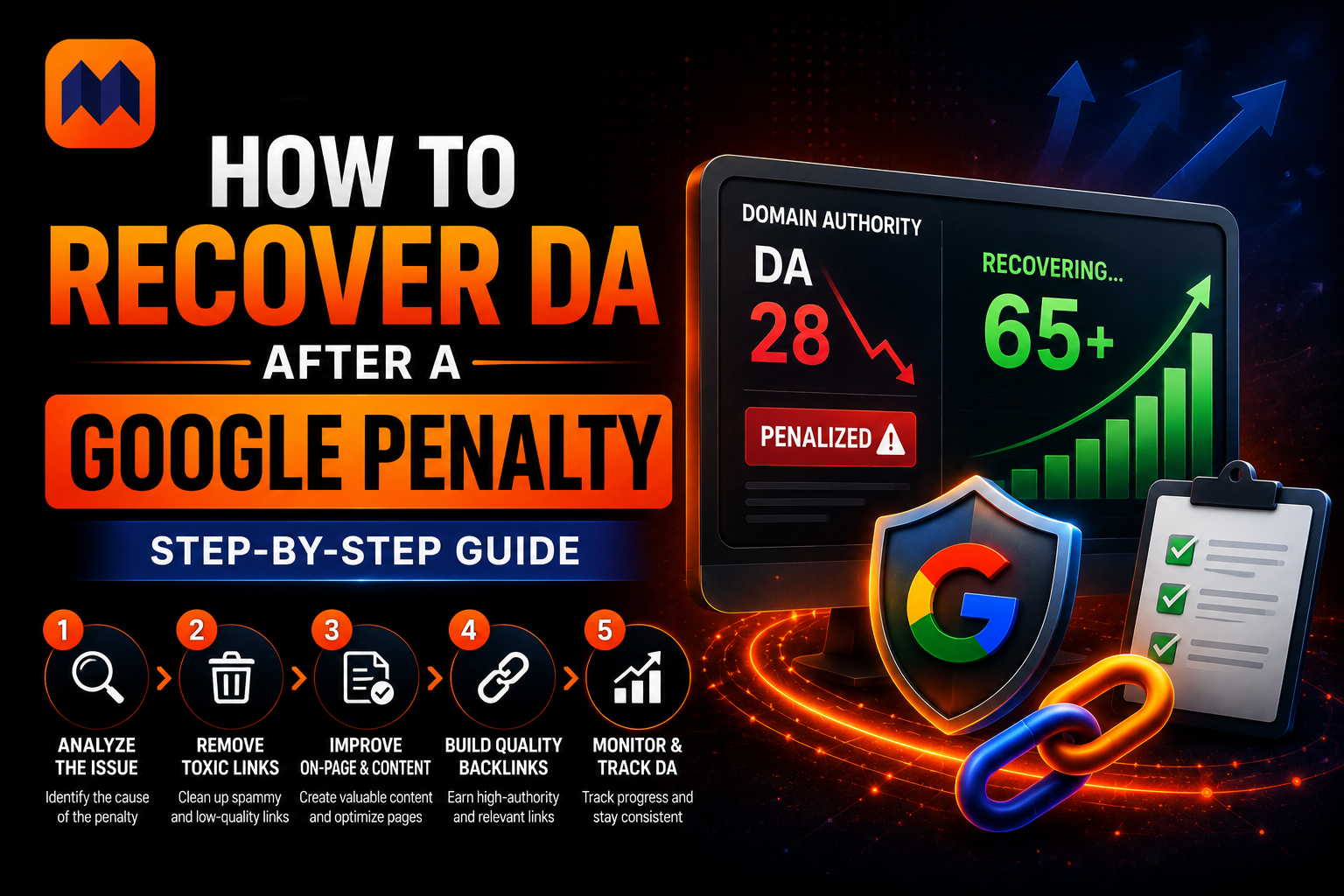
This guide walks you through the full recovery process in order. Do each step properly, and your domain authority will rebuild. Check Da authority using our Tool
What a Google Penalty Actually Does to Your DA
Before jumping into fixes, it’s worth understanding what you’re actually recovering from — because “domain authority” and “Google ranking signals” aren’t the same thing.
Domain Authority (DA) is a Moz metric — built from your backlink profile: how many referring domains point to you, how strong they are, and how much link equity flows into your root domain. Google doesn’t use DA as a direct ranking factor. But a penalty tanks the same backlink signals that drive DA, so both numbers tend to fall together and recover together.
A penalty — manual or algorithmic — tells Google to stop counting the link equity from manipulative or low-quality backlinks. Your rankings fall. Traffic follows. And since DA is built on those same links, it drops right alongside your search visibility.
Getting back means running two tracks at once: cleaning up whatever triggered Google’s response, and rebuilding the genuine authority that earns rankings. The steps below cover both in sequence.
Step 1 — Diagnose: Manual Penalty or Algorithmic Suppression?
From the traffic data alone these two look identical. The recovery path for each is completely different.
Manual penalties come from an actual person at Google — someone on the search quality or webspam team who reviewed your site and found a violation. You’ll see the notification in Search Console under Security & Manual Actions → Manual Actions. Common triggers: unnatural inbound links, thin or spun content, structured data abuse, user-generated spam.
Algorithmic suppressions are different — no human reviewer, no email, no Search Console notification. They come from Google’s systems: Penguin, the Helpful Content update, core updates. They show up as a traffic collapse or slow bleed that lines up with a known update rollout date. No manual action in GSC but traffic cratered right after a core update? That’s an algorithmic hit.
Check Google Search Console first. If there’s a manual action listed, you know exactly what you’re fighting. If GSC is clean, cross-reference your traffic drop date against Google’s publicly announced update history. The algorithm that caused the hit determines the fix.
Manual penalties require a reconsideration request after you fix the problem. Algorithmic suppressions don’t — they resolve automatically when Google re-crawls and detects that you’ve meaningfully improved the signals that triggered the suppression.
Step 2 — Run a Full Backlink Audit
Whether your penalty is manual or algorithmic, your backlink profile is the most likely culprit — and the first thing to clean up.
Pull your full link profile using Ahrefs, SEMrush, or Moz. Look for these specific red flags:
- Exact-match anchor text concentration. If 40% of your anchors are all the same commercial keyword, that’s a manipulation signal Google’s systems are built to catch.
- Links from link farms, PBNs, or low-quality directories. Sites with DR/DA under 10, irrelevant niches, or obvious spam patterns.
- Paid link footprints. Sitewide footer links from unrelated sites, links appearing in bulk from the same IP ranges or hosting providers.
- Sudden link velocity spikes. A site that earned 3 links a month for two years and then 400 links in one month has an unnatural acquisition pattern.
Export everything to a spreadsheet. Tag each domain as Keep, Investigate, or Remove. Don’t rush this — a sloppy audit leads to over-disavowing, and removing good links weakens your authority further. Work through the full list before touching the disavow tool.
Step 3 — Remove Toxic Links and Use the Disavow Tool Carefully
This step has two phases: outreach first, disavow second.
Phase 1 — Direct removal outreach. Contact the webmasters running the worst offending sites. Keep the email short — say you’re cleaning your link profile and want the link removed. Log every attempt: the domain, the date sent, and the response (or non-response). That paper trail matters when you write your reconsideration request.
Realistically, maybe 20–30% of webmasters will respond and actually remove anything. Don’t stress the low rate — Google cares that you tried, not that you hit 100% removal. The documentation of your effort is what carries weight.
Phase 2 — Disavow. The Google Disavow Tool is powerful and permanent. Use it only for links you’ve already tried to remove manually, plus any domains so obviously toxic that outreach isn’t worth the effort (link farms, scrapers, known spam networks).
Upload a .txt file via Google Search Console in this format:
# Disavowing toxic domains identified in backlink audit – [date]
domain:spamsite1.com
domain:linkfarm-example.net
The most common mistake here: over-disavowing. Many site owners panic and disavow their entire link profile to “be safe.” This strips out legitimate link equity and makes your DA drop further. The goal is surgical removal of manipulative patterns — not sterilizing everything.
Step 4 — Audit and Fix Your Content
Link issues cause most manual penalties. But algorithmic suppressions — especially from the Helpful Content system and core updates — are usually content-driven.
Work through your site and flag pages that fall into these categories:
- Thin content — pages that are more placeholder than resource: under 300 words, no real depth, nothing a reader couldn’t find better somewhere else. Expand them with genuine substance or remove and redirect to a relevant page.
- Duplicate content — multiple pages chasing the same keyword with near-identical copy, or third-party content republished without anything meaningfully added. Consolidate, canonicalize, or cut.
- Unhelpful content — pages written to rank, not to answer a question. Google’s Helpful Content system doesn’t penalize individual pages in isolation; it suppresses the whole domain when enough of your content falls into this bucket. If your traffic dropped across the board rather than on specific pages, this is where to look first.
- Keyword-stuffed pages — content where the target phrase appears so many times it stops sounding like writing and starts sounding like a keyword list. Read it aloud. If it sounds wrong to you, it reads wrong to Google.
For each category, decide: fix it, merge it with a related page, or delete and redirect. Don’t just add words to thin pages without improving the actual usefulness of the content. Google evaluates quality signals, not length.
Step 5 — Submit a Reconsideration Request (Manual Penalties Only)
If your penalty is manual, you need to formally request Google review your fixes before the penalty lifts. Algorithmic suppressions skip this step entirely — they resolve automatically at the next crawl or update cycle.
A strong reconsideration request has three parts:
1. Document exactly what you found and what you fixed. Don’t be vague. “We audited our backlink profile, identified 340 domains with manipulative patterns, and contacted 210 webmasters directly (outreach log attached). Of those, 90 links were removed. The remaining 120 — sites that never responded or refused outright — are included in the disavow file attached to this request.”
2. Show your evidence. Attach your outreach log, the disavow file, and before/after screenshots from your backlink audit. A reviewer who can see exactly what you did moves much faster than one who has to take your word for it.
3. Show it won’t happen again. Don’t just say the problem is fixed — explain the process you’ve put in place to keep it fixed. Switched SEO agencies, implemented quarterly link audits, rewrote your editorial standards — whatever it is, be specific about it.
Google typically takes 2 to 6 weeks to review a reconsideration request. If they deny it, that’s not the end — it means something in your cleanup wasn’t thorough enough. Go back through the audit, dig deeper, fix what’s still there, and resubmit.
Step 6 — Rebuild Domain Authority with Clean Link Acquisition
Lifting the penalty doesn’t flip a switch. Whether Google removed a manual action or a re-crawl confirmed your algorithmic fixes, the authority you lost doesn’t come back automatically. You have to earn it back through legitimate link acquisition.
The manipulative links that inflated your DA before are gone. The legitimate links that should replace them need to come from actual editorial placements.
Effective post-penalty link building:
- Digital PR. Commission or produce original research — an industry survey, a data study, a benchmark report in your niche. Something journalists can cite and bloggers actually want to link to. One well-executed data piece regularly earns more editorial links than months of cold outreach.
- Journalist sourcing platforms (HARO, Qwoted, Featured.com). Answer media queries in your industry. When a journalist quotes you and links back from a real news publication, that earned mention carries trust signals that Google’s algorithm treats very differently from a link you arranged through a network or paid for.
- Guest posting on legitimate publications. Not link farms or mass outreach networks. Actual publications in your industry with real editorial standards and genuine audiences.
- Reclaiming unlinked brand mentions. Use Ahrefs Alerts or Google Alerts to find sites that mention your brand without linking. A polite outreach email converts many of these into backlinks with no effort beyond the ask.
One point that doesn’t get enough attention: E-E-A-T signals also contribute to authority recovery. Google evaluates Experience, Expertise, Authoritativeness, and Trustworthiness at the site and author level. Publishing content with real author credentials, citing primary sources, and demonstrating genuine subject matter expertise helps rebuild the trust signals that a penalty damages — even beyond the link profile.
How Long Does DA Recovery Actually Take?
Set your expectations early, because this isn’t a 2-week fix.
| Penalty Type | Typical Recovery Timeline |
| Manual penalty (links) | 2–6 months after reconsideration approval |
| Manual penalty (content) | 4–8 weeks after fixes are implemented |
| Algorithmic — Penguin | Resolves at next core update cycle (3–6 months) |
| Algorithmic — Helpful Content | Can take 6–12 months; requires sustained content quality improvement |
| Core update suppression | 3–6 months; tied to next core update rollout |
The DA metric itself lags behind actual ranking recovery. Moz refreshes DA scores periodically — not in real time. So your rankings may start recovering before your DA number reflects it. Track organic traffic and keyword positions alongside DA to get a more accurate picture of where you actually stand.
Mistakes That Extend Your Recovery Timeline
Most penalty recoveries take longer than they should because of specific, avoidable errors.
Over-disavowing. This strips out legitimate authority alongside the toxic links. If your DA drops after you disavow, this is why. Only disavow at the domain level for domains you’re genuinely confident are manipulative — bulk-disavowing everything that looks even slightly questionable is how people gut their own link profile in a panic.
Filing your reconsideration request before the cleanup is done. Google’s reviewers aren’t approving partial fixes — they’ll spot the remaining manipulative links and deny the request outright. You don’t get partial credit here. Finish the full cleanup first, then submit once.
Fixing the symptom but not the cause. If a previous SEO agency built your toxic links, replacing their work with another link scheme restarts the clock. Post-penalty link building must be fundamentally different in quality and acquisition method.
Publishing more content without fixing existing content. If your algorithmic suppression is content-driven, adding new pages doesn’t help. Google evaluates site-wide helpful content signals. Forty good new articles won’t offset three hundred thin existing pages. Fix the existing problems first.
Waiting for traffic to recover before rebuilding links. These two tracks should run in parallel once the cleanup is done. Every month you wait on link acquisition is a month of DA recovery left on the table.
Conclusion on Recover DA After a Google Penalty
Recovering DA after a Google penalty is a methodical process, not a quick reset. Diagnose the penalty type correctly. Clean your backlink profile with surgical precision — not panic. Fix your content to meet the quality signals Google now requires. Document everything, then request reconsideration if the penalty was manual. Rebuild authority through earned links and genuine E-E-A-T signals.
It takes 3 to 6 months for most sites. It takes longer for sites that skip steps or make the mistakes outlined above. Follow the sequence here, do each stage properly, and your domain authority will recover — and sit on a foundation that won’t collapse again.