Does DA Matter in the Age of AI Search? (2026 Update)
You’ve spent years building backlinks and pushing your DA up. Then ChatGPT launches AI Overviews and Perplexity starts answering questions your site should own. But it’s not citing you.
A competitor with DA 22 keeps getting cited. Your DA 55 site is invisible to the AI.
This guide gives you the 2026 honest answer: where DA still matters, where it doesn’t, what AI search actually looks for, and how to optimize for both without starting over.
Read More: DA/Pa Checker
The 2026 Answer: DA Still Matters, But Not Where You Think
For traditional Google search, DA still works as a competitive signal. The sites ranking in organic top-10 positions for competitive keywords still tend to have strong backlink profiles and high DA. That hasn’t changed.
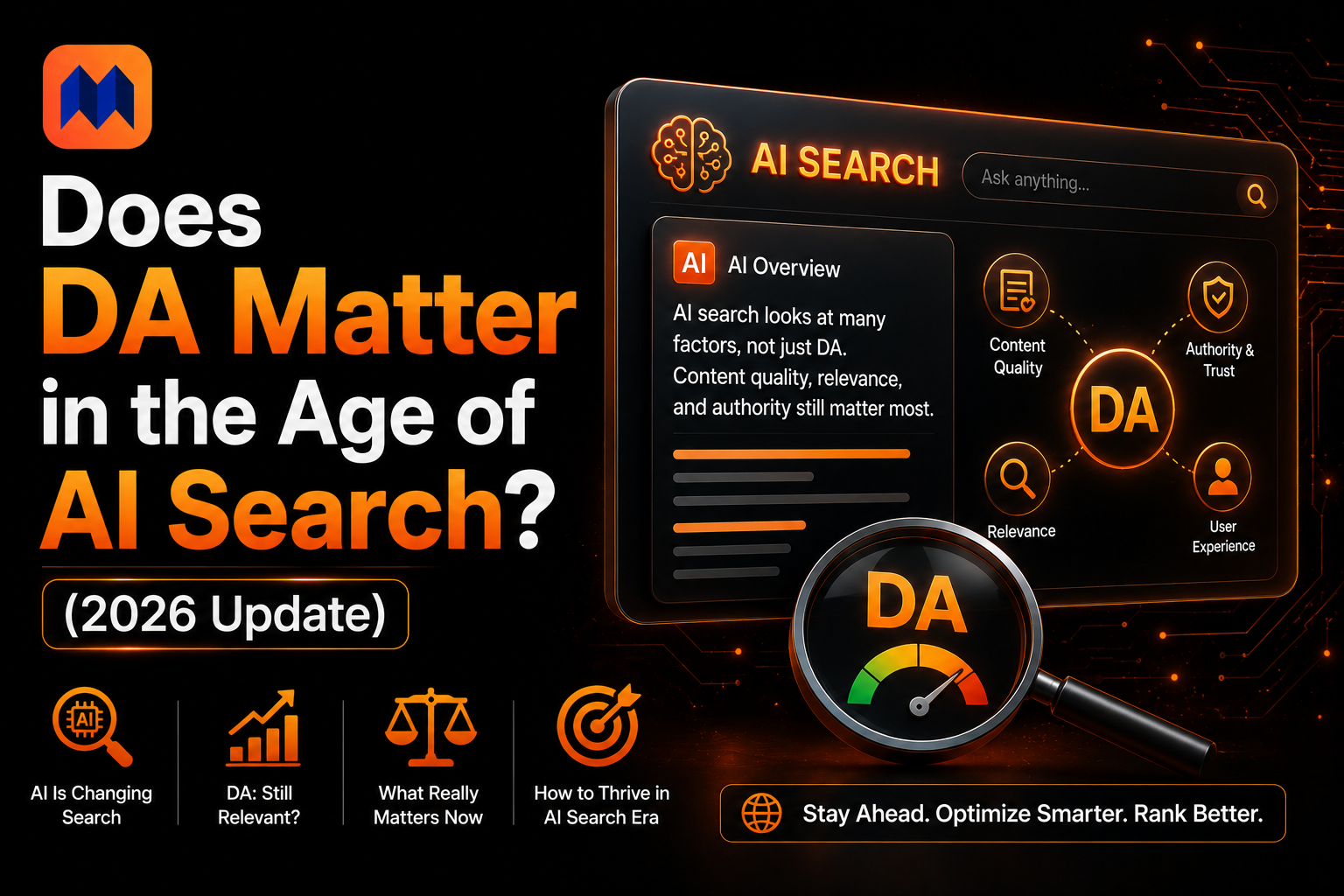
What changed is the AI layer on top of that. Google AI Overviews, ChatGPT Search, and Perplexity select their cited sources through a completely different mechanism than organic rankings. And in that system, DA predicts very little.
The numbers are stark. BrightEdge’s February 2026 analysis of 863,000 keywords found that only 38% of Google AI Overview citations came from pages in the organic top 10 — down from 76% just seven months earlier. For standalone AI platforms like ChatGPT and Perplexity, only 12% of cited URLs appear in Google’s top 10 results at all.
DA is still a useful metric. It just stopped being the primary one for the fastest-growing part of search.
A site with DA under 10 outperformed Ahrefs (DA 92) on AI citation rate by 3x in documented 2026 benchmarks. The lower-DA site contained original benchmark data structured for machine reading. The higher-DA site published solid content but wasn’t built for AI citability.
How AI Search Engines Actually Select Sources in 2026
Understanding why DA disconnected from AI citations requires knowing how these systems pick sources. It’s not a ranking algorithm. It’s closer to a fact-verification system.
When ChatGPT, Perplexity, or Google’s AI generates an answer, it’s asking one question: “What is the safest, most verifiable thing I can repeat without being wrong?”
That question points to different signals than backlink volume:
- Author credentials — named authors with verifiable expertise are cited more than anonymous content, regardless of domain DA
- Original data — AI must cite the originator of a unique fact or statistic. Content that creates original data gets cited by necessity
- Structured content — answer-first writing, schema markup, clear headings, and machine-readable formatting increase citation rates by a documented 65%+ over unstructured content
- Third-party corroboration — brand mentions across independent trusted sources (not links from your own site) signal that the AI can safely repeat your claims
- Content freshness — 23% of AI-cited content in 2025 was under 30 days old. AI engines show a clear recency bias that DA doesn’t factor in at all
Ahrefs’ 2026 study of 75,000 brands confirmed the inversion: brand mentions correlate 3 times more strongly with AI Overview visibility than backlinks (r=0.664 vs r=0.218). The metric that drives AI citations isn’t DA. It’s how often trusted, independent sources mention your brand or reference your content.
Traditional Search vs AI Search: Signal Comparison
Here’s how the two systems compare across the signals that drive visibility:
| Signal | Traditional Search / DA | AI Search Engines (2026) |
| Primary signal | Backlink count and quality | E-E-A-T signals, brand mentions, structured data |
| DA/DR relevance | High — core metric | Low for AI citation, moderate for Google Overviews |
| Author identity | Not tracked by Moz/Google | High — named experts with credentials cited more |
| Content structure | Moderate | Critical — answer-first, schema markup, headings |
| Brand mentions | Indirect (links convert to DA) | 3× stronger predictor than backlinks (Ahrefs, 2026) |
| Original data | Good for earning links | Primary citation trigger — AI must cite the source |
| Traffic signals | Moderate input via Semrush AS | Not used directly by LLMs |
| Update frequency | Monthly (Moz) | Matters — 23% of AI cited content is under 30 days old |
The brand mentions row tells the most important story. DA is built on backlinks — links that pass equity and push the score up. AI engines care about brand mentions more than link equity. A mention in a trade publication without any link still builds the citation trail AI systems use to assess credibility.
This doesn’t mean links stopped mattering. It means the reason links matter changed. Links now build AI visibility primarily through the brand mentions and cross-domain corroboration they create — not through the PageRank flow that Moz measures in DA.
Where DA Still Matters in 2026
DA hasn’t become useless. It’s become context-specific. Here’s exactly where it still earns its place:
| Use Case | DA Relevance | Notes |
| Traditional Google organic results | High | DA correlates strongly with top-10 positions |
| Google AI Overviews | Medium | 76% of AI Overview citations overlap with organic top 10 |
| ChatGPT / Perplexity citations | Low | Only 12% of cited URLs appear in Google top 10 |
| Claude / Gemini responses | Low | Primary trust signals are E-E-A-T, not DA |
| Backlink outreach prospecting | High | DA still the standard filter for link building targets |
| Guest post site evaluation | High | DA + Spam Score remain primary vetting tools |
| Link buying / domain purchase | Medium | DA useful but easily inflated — cross-check traffic |
| Competitor authority benchmarking | Medium | Relative DA still useful for niche comparisons |
The Google AI Overviews row is worth highlighting. Since AI Overviews pull heavily from pages already ranking in the top 10, and DA correlates with those top-10 positions, DA does indirectly influence AI Overview inclusion — just not as a direct signal.
For ChatGPT and Perplexity, the disconnect is nearly complete. These platforms don’t use Google’s index as their primary source. They rely on training data, live web search, and trusted domain registries that don’t weight DA at all.
For link building, outreach, and guest post evaluation, DA remains the standard. The industry hasn’t moved to a different metric for these use cases because nothing comparable replaces it. If you’re vetting a domain for a backlink placement, DA combined with Spam Score is still the fastest filter available.
What DA Cannot Measure — And Why That Gap Is Growing
DA measures backlink profile strength. Always has. The problem is that backlink profile strength is becoming a smaller slice of the signals that determine online authority in 2026.
E-E-A-T Signals
Google’s own quality guidelines emphasize Experience, Expertise, Authoritativeness, and Trustworthiness. None of these show up in DA. A site with DA 40 where every article is written by named industry experts with verifiable credentials is far more E-E-A-T compliant than a DA 60 site with anonymous content and a generic author bio.
Research shows 96% of Google AI Overview citations come from sources with strong E-E-A-T signals. DA doesn’t predict E-E-A-T. The two metrics are largely independent.
Entity Signals
AI systems evaluate entities — recognizable brands, people, organizations, and topics that exist in knowledge graphs. A domain that Wikidata knows about, that appears consistently across Wikipedia, LinkedIn, Google Business Profile, and major industry directories, has strong entity signals regardless of its DA.
Pages with 15 or more recognized entity references show 4.8 times higher AI Overview selection probability than pages without them. DA tracks none of this.
Citation Density
How often trusted sources mention your brand name independently of links is now a primary predictor of AI visibility. SE Ranking’s November 2025 study found that domains with millions of brand mentions on platforms like Quora and Reddit have roughly 4 times higher chances of ChatGPT citation than sites with minimal cross-platform presence.
You can have a DA of 50 and near-zero citation density. A brand that publishes original research monthly and distributes it through earned media builds citation density without necessarily building DA at the same rate.
How to Optimize Both Traditional Search and AI Search
The good news: what builds AI citability largely reinforces traditional SEO. These are not competing strategies. Most of the investments below improve both your DA trajectory and your AI citation rate simultaneously.
Keep Building High-Quality Backlinks
Backlinks remain the foundation of DA and still influence Google AI Overviews indirectly through organic ranking. But refocus the type of links you pursue. Links from high-authority editorial sources matter more than ever — not just for DA, but because those editorial placements create the brand mentions and third-party corroboration that AI engines look for.
A dofollow link from an industry publication with 200,000 monthly readers does more than a dofollow link from a DA 40 blog with 500 readers. The publication’s readers, social shares, and reputation pass authority that extends beyond what Moz measures.
Publish Original Data and Research
This is the single highest-leverage action for AI citability. When you own a unique statistic, study, or benchmark, AI engines have to cite you to include that information. They can’t paraphrase data that only exists on your site.
One original study per quarter consistently cited by others in your niche builds citation density faster than any other content strategy. The 2026 data shows that distributing original content through a wide range of publications increases AI citations by up to 325% compared to only publishing on your own domain.
Add Author Credentials and Structured Data
Every article should have a named author with a verified professional profile. Add their credentials, link to their LinkedIn or professional bio, and use Person schema markup so search engines and AI engines can verify who wrote the content.
Content with verifiable author credentials gets higher E-E-A-T scores and shows up more consistently in AI-cited results. Anonymous content, regardless of how strong the domain DA is, gets deprioritized in AI citation selection.
Structure Content for Machine Readability
Answer-first writing, clear headings, FAQ schema, and How-To schema all make content easier for AI engines to extract and cite. The Growth Memo’s February 2026 analysis found that 44.2% of all LLM citations come from the first 30% of text — the introduction.
If your core answer isn’t in your opening paragraphs, AI engines may pass on your content even when your DA is strong. Write like you’re answering the question immediately, then expand. AI citation behavior rewards directness in a way that traditional SEO never quite demanded.
Build Cross-Platform Brand Presence
Domains with profiles on platforms like Trustpilot, G2, Capterra, and industry-specific review sites show 3 times higher ChatGPT citation probability than domains without such presence. Wikipedia mentions, Wikidata entity registrations, and consistent LinkedIn and industry directory presence all contribute to entity signals that DA never captured.
Conclusion on Does DA Matter in the Age of AI Search
DA isn’t dead. It’s just no longer the whole story. For traditional organic search, it’s still the best proxy for backlink profile strength and competitive ranking potential. For AI search, it’s almost irrelevant as a direct citation signal.
The smart approach in 2026 is to keep building the backlink quality that drives DA — but to pursue that backlink quality specifically through high-authority editorial placements that also create the brand mentions, original research citations, and third-party corroboration that AI engines trust.
DA and AI citability aren’t opposite directions. They’re the same direction with a different destination in mind. Earn links from places that matter. Create content that only you own. Name the people who write it. Structure it so machines can read it. That strategy builds both, without choosing one over the other.