

You spent three hours writing a guest post. You pitched a site with DA 45. It got published. Six months later, your rankings didn’t move.
The site looked strong. The DA said so. But nobody checked the Spam Score, the traffic, or whether that page would even pass link equity.
This guide shows you exactly how to use a DA PA checker for guest posting — what to check, how to read the numbers, which sites to skip, and how to build a prospect list worth pitching.
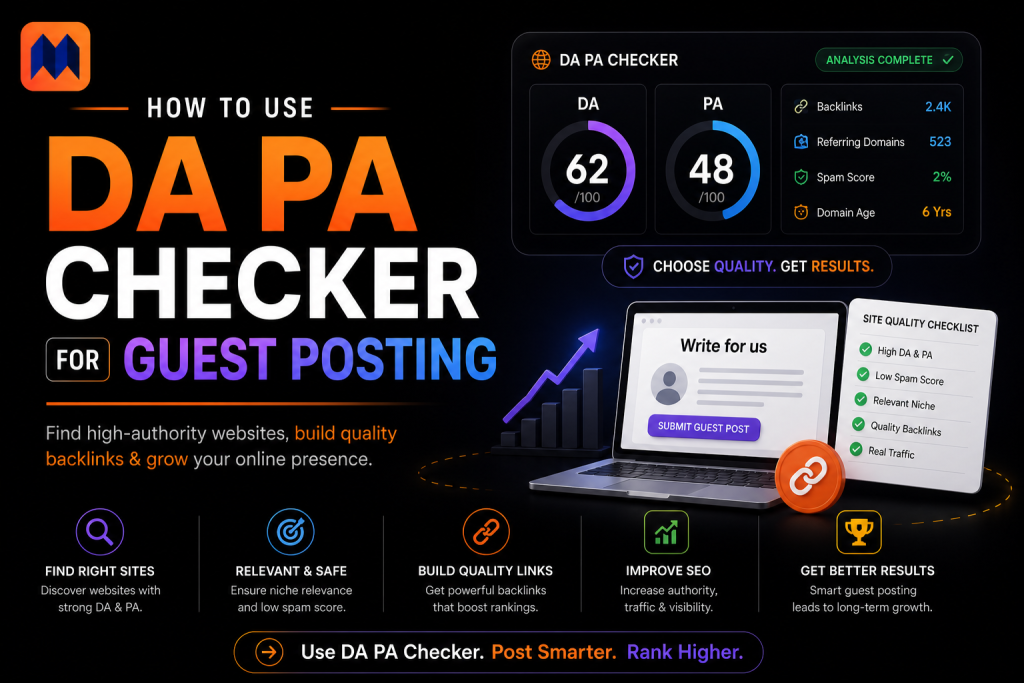
Why DA and PA Matter When You’re Guest Posting
Guest posting earns you a backlink. That backlink either helps your SEO or it doesn’t. The difference usually comes down to where the link comes from.
A link from a high-DA, clean site passes real authority to your domain. A link from a low-DA or spammy site does little at best — and can hurt your profile at worst if the site sits in a bad neighborhood.
DA (Domain Authority) tells you how strong a site’s overall backlink profile is. PA (Page Authority) tells you how much authority a specific page carries. For guest posting, you need both:
DA tells you whether the site is worth your time at all
PA tells you whether the specific page your post will live on can pass meaningful link equity
Spam Score tells you whether linking from this site could damage your profile
None of these metrics are Google’s official ranking signals. Google doesn’t use DA or PA. But they correlate strongly with sites that rank, earn real traffic, and pass authority through their links. That correlation is why experienced link builders run every guest post prospect through a DA PA checker before sending a single pitch.
Step-by-Step: How to Use a DA PA Checker for Guest Posting
The process takes about 10 minutes per batch of sites. Here’s exactly how to do it properly.
Step 1 — Build Your Prospect List First
Don’t start the checker with one URL at a time. Build a list first. Use Google search operators to find sites in your niche that accept guest posts:
- your niche + “write for us”
- your niche + “guest post guidelines”
- your niche + “submit a post”
- your niche + “contribute”
Collect 20–50 candidate URLs before you run anything. Bulk checking is faster than one-by-one and lets you compare sites against each other in a single view.
Step 2 — Run the Bulk DA PA Check
Paste your list into a bulk DA PA checker. Good tools accept 10–1,000 URLs at once, depending on the platform. Free tools typically handle 10–25 URLs per run. Enter one domain per line and hit check.
The results will show DA, PA, Spam Score, total backlinks, and sometimes referring domains. Download the results as CSV so you can sort and filter without repeating the check.
Step 3 — Filter by DA Minimum
Sort by DA from highest to lowest. Set your minimum threshold based on your own site’s DA and your niche competitiveness:
- New or small site (DA under 20): Target guest post sites with DA 20–40
- Mid-range site (DA 20–40): Target guest post sites with DA 30–50
- Established site (DA 40+): Target guest post sites with DA 40–60+
A guest post on a site with DA lower than yours rarely moves the needle. Aim at least at your own level, ideally above it.
Step 4 — Check Spam Score for Every Remaining Site
After filtering by DA, run Spam Score against every site still on your list. This is where most people stop too early.
Spam Score flags how closely a domain resembles sites Google has penalized or deindexed. A clean DA 35 site is a solid target. A DA 35 site with 70% Spam Score is not — the link it gives you sits in a neighborhood of penalized domains.
Use this filter: Remove any site with Spam Score above 30% unless you can manually verify its backlink profile is clean. Above 50% is almost always a skip.
Step 5 — Check PA on the Specific Guest Post Page
Most guest posting guides stop at DA. That’s a mistake. DA tells you about the whole domain. The link in your guest post comes from a specific page.
If the site publishes guest posts in a /blog/ subfolder or a dedicated /guest-posts/ section, check the PA on those pages. If they’re pulling PA 10–15, your link won’t carry much weight even if the domain has DA 45.
Run the URLs of a few recent guest posts from the site through the PA checker. If those pages sit at PA 20 or higher, you’re getting real link equity. Below PA 15 on inner pages of even a DA 40 site is a red flag worth noting.
Step 6 — Verify with Traffic Data
One last check before pitching: estimate the site’s organic traffic. DA can be inflated through link buying. Traffic cannot be faked at scale.
A site with DA 40 and near-zero organic traffic almost certainly bought its way to that score. Your guest post link from that site passes little or nothing. Use a free traffic estimator — Semrush, Ahrefs, or SimilarWeb all offer rough estimates without a paid plan.
If DA looks strong but traffic looks dead, skip it. This combination is the clearest signal that authority was purchased rather than earned.
Guest Post Site Vetting Scorecard
Once you have DA and Spam Score data in front of you, here’s how to interpret every combination:
| DA Score | Spam Score | Decision | Notes |
| DA below 20 | Spam Score any | Skip | Too weak unless it’s your own niche with zero competition |
| DA 20 – 30 | Below 20% | Proceed | Good for niche sites; verify traffic before committing |
| DA 20 – 30 | Above 40% | Skip | Risk outweighs the link value at this authority level |
| DA 30 – 50 | Below 20% | Strong | Solid guest post target in most niches |
| DA 30 – 50 | 20% – 40% | Review | Manual check needed; look at backlink sources |
| DA 30 – 50 | Above 60% | Skip | High spam with moderate DA is a red flag |
| DA 50+ | Below 20% | Priority | High authority, clean profile — pitch this one first |
| DA 50+ | Above 40% | Caution | Even strong DA doesn’t protect against a toxic link profile |
The “Review” decisions require a manual pass. Open the site, read three or four articles, check who’s linking to it in a backlink tool, and look at whether content is recent and original. Numbers narrow the list — your eyes close it.
Green Flags vs Red Flags — What to Look for Beyond the Numbers
DA and Spam Score tell you a lot. They don’t tell you everything. After the numbers pass, these manual signals separate a genuine guest post opportunity from a link farm wearing a high DA mask:
| ✅ Green Flags — Worth Pursuing | ❌ Red Flags — Skip This Site |
| DA 30+ with Spam Score under 20% | DA looks inflated but organic traffic is near zero |
| PA 20+ on the specific guest post page | Spam Score above 50% regardless of DA |
| Real organic traffic visible in traffic tools | No author bios or author pages on the site |
| Active comments or social shares on posts | Every post is a guest post with do-follow links |
| Content published regularly in the last 6 months | Same topic covered 10+ times with thin content |
The “every post is a guest post” pattern is the most reliable red flag most beginners miss. Sites that publish only guest content with do-follow links exist specifically to sell those links. Google knows about these sites. The links they pass are worth very little, sometimes negative.
What Minimum DA Should You Set for Guest Posts?
There’s no single right answer. The minimum that makes sense depends on two things: your own site’s current DA and how competitive your niche is.
General Thresholds by Situation
For a brand-new site with DA under 10, any clean link from DA 20+ with low Spam Score helps. Don’t be too selective when you’re starting out. At that stage, getting links from real sites that get real traffic matters more than chasing DA 50.
For sites in the DA 20–40 range, set a minimum guest post threshold of DA 30. Below that, the return rarely justifies the effort of writing and pitching a full post. You want to be reaching up, not sideways.
Once your site crosses DA 40, the calculus shifts. Links from DA 20–25 sites contribute marginally to your profile. Concentrate effort on DA 40+ sites with low Spam Scores and demonstrated organic traffic. Quality of links matters more than volume at this stage.
Niche Competitiveness Adjusts Everything
In a low-competition niche — a specific type of craft, a regional service, a narrow B2B topic — DA 25–35 sites are often the strongest available. Holding out for DA 50 means pitching almost nobody. Work with the niche you’re in.
In high-competition niches like finance, health, or SaaS, DA 50+ sites are the standard for links that move the needle. Anything below DA 35 rarely contributes meaningfully when you’re competing against sites with DA 70–80.
How to Build a Guest Post Prospect Sheet Using DA PA Data
A checker gives you raw data. A tracked sheet turns that data into a repeatable outreach system. Here’s how to build one properly.
Columns to Track
Export your DA PA checker results into a spreadsheet. Add these columns alongside the checker data:
1. Site URL — root domain only
2. DA — from checker
3. PA of guest post section — check /blog/ or /guest-posts/ URL separately
4. Spam Score — from checker
5. Estimated traffic — note source (Semrush, Ahrefs)
6. Niche relevance — Yes / Partial / No
7. Guest post guidelines URL — where to find submission rules
8. Contact email — editor or webmaster
9. Pitch status — Not Sent / Sent / Accepted / Published
10. Date published — for tracking link age
Prioritization Formula
Once your sheet is populated, prioritize rows using this simple scoring logic:
- DA 50+ and Spam Score under 15%: Tier 1 — pitch first, invest most effort
- DA 35–49 and Spam Score under 25%: Tier 2 — good targets, pitch second
- DA 20–34 and Spam Score under 20%: Tier 3 — pursue only if niche relevance is high
- Any site with Spam Score above 40%: Remove — don’t pitch regardless of DA
Re-run your list through the checker every 60 days. Sites’ DA and Spam Scores change. A site that was borderline three months ago might have cleaned up. One that looked great might have tanked.
Common Mistakes When Using DA PA for Guest Posting
Most people learn these the hard way. Skip the expensive lessons.
Checking DA but Ignoring PA on the Actual Page
The link lives on a page, not on a domain. DA 50 with PA 8 on the guest post page is a weak link. Always check both, separately.
Trusting DA Without Verifying Traffic
DA can be bought. Traffic at scale cannot. A site with DA 40 and 200 monthly organic visitors bought that DA. Your link from it is worth next to nothing.
Ignoring Spam Score Because DA Looks Strong
High DA and high Spam Score is a red flag, not a pass. Some sites accumulate strong backlinks alongside a toxic backlink profile. The two numbers co-exist. Spam Score doesn’t care about DA.
Pitching Sites That Only Publish Guest Posts
A site where 90% of posts are by different contributors with do-follow links is a link farm. Google has been targeting these since 2022. Even with DA 45, a link from a site like this offers minimal value and carries real risk.
Setting the Same Minimum DA Regardless of Niche
DA 35 is excellent in a niche where the top sites average DA 30. It’s weak in a niche where every competitor runs DA 60+. Benchmarks should come from your actual competitive landscape, not arbitrary targets.
Conclusion
A DA PA Checker is the first filter in a guest posting workflow, not the whole process. DA tells you whether a site is worth approaching. PA tells you whether the page carrying your link is strong enough to matter. Spam Score tells you whether the neighborhood is safe.
Run all three checks. Set thresholds based on your niche, not arbitrary numbers. Always verify traffic before you write and pitch. Build a tracked spreadsheet so you stop repeating the same research every time you outreach.
The sites that move your rankings aren’t the ones with the highest DA on paper. They’re the ones with real traffic, clean profiles, and pages that carry genuine authority. The checker gets you close. Your judgment gets you the rest of the way.
Frequently Asked Questions
What is a good DA for a guest post site?
It depends on your own site’s DA and your niche. A general rule: target guest post sites with DA at or above your own current score. For new sites under DA 20, any clean DA 20–30 site is a good start. For established sites at DA 40+, focus on DA 40–60 with low Spam Scores and verified organic traffic. The goal is to reach up, not sideways.
How much does Spam Score matter for guest posting?
A lot more than most people realize. A Spam Score above 40–50% means the domain shares many signals with sites Google has penalized or deindexed. Even with a high DA, a link from that domain can drag your profile into bad backlink territory. Always check Spam Score alongside DA and skip anything above 40% unless you can manually verify the backlink profile is clean.
Should I check PA or DA for guest posting decisions?
Both, at different stages. DA first — it tells you whether the site is worth targeting at all. PA second — it tells you whether the specific page where your post will live can pass meaningful authority. Check the PA of the site’s /blog/ or guest post index page, and also check the PA of a few recently published guest posts. If inner pages sit at PA 10–15 on a DA 40 site, your link value will be lower than the DA implies.
Can I use a free DA PA checker for guest posting research?
Yes, for most individual checks. Free DA PA checkers work for vetting 5–25 sites at a time and give you the same Moz API data as paid tools. The limitation is volume — free tools typically cap at 10–25 URLs per run or a certain number of daily checks. For agencies or large-scale prospecting across hundreds of sites, a paid plan or API access becomes necessary. Free is fine for individual bloggers and small teams.
What is the minimum DA I should accept for a guest post?
There is no fixed minimum that applies everywhere. For most small sites early in their SEO journey, DA 20–25 with low Spam Score and real traffic is acceptable. For mid-range sites, DA 30–35 is a reasonable floor. For competitive niches and established sites, set the bar at DA 40+. Always adjust based on what’s available in your niche — in tight verticals, insisting on DA 50 might mean pitching almost nobody.
How often should I re-check DA and Spam Score on my prospect list?
Every 60 days is a practical cadence for active prospect lists. Moz updates DA and Spam Score monthly, so checking more often than that gives you no new data. Sites can change significantly over two months — a penalty or algorithm update can drop a site’s effective authority without changing its DA immediately. Traffic verification every 60 days catches these changes before you invest outreach time in a site that has been hit.

Writes about SEO, link building and domain authority.