What is Spam Score and how does it affect Your SEO Ranking
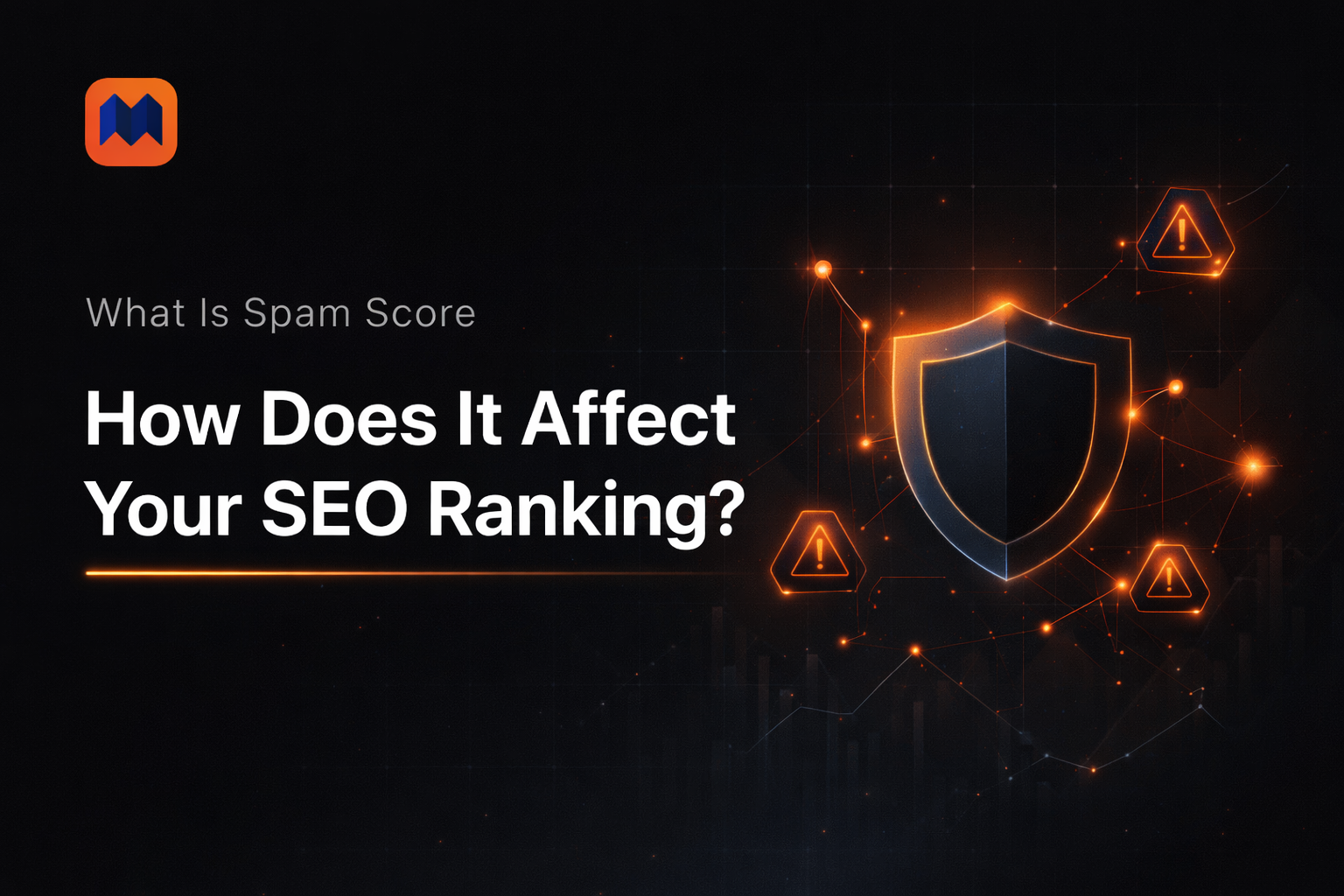
One measure that helps determine a website’s authority is its Spam Score. Accordingly, a website with a high spam score is not as trustworthy as one with a low one. It affects a site’s SEO ranking since it adds to the site’s credibility.
What follows is an explanation of the how and why of that phenomenon. Put simply, we shall provide a comprehensive explanation of spam ratings. Marketers, if you want to know how to raise a site’s SEO rating, you should read this piece.
What is Spam Score in SEO?
When people talk about “Spam Score” in relation to SEO (Search Engine Optimization), they usually mean a statistic that Moz, a well-known SEO software supplier, created. The purpose of Moz’s Spam Score is to foretell the probability that search engines may punish or prohibit a website owing to questionable actions or connections.
If you’re having trouble wrapping your head around the idea of spam score, this broad comparison should assist. Learn how it affects search engine optimization now. The search engine has negative feelings about your website when its spam score is high.
In such a situation, the website may still be accessible via the search engine. A drop in search engine ranking is one example of a less severe penalty. Accordingly, that is the connection between search engine optimization and spam score. Your SEO performance will suffer if your spam score is high for an extended length of time.
Importance of Spam Score for SEO
You shouldn’t limit your usage of spam score to tracking a site’s decline. To learn where a site is vulnerable, it is also an excellent measure to use. Put simply, you may use this score to identify any problems with your site and implement fixes to enhance its performance.
You can figure out why your site has a lot of spam if you are aware of the things that influence spam scores. This manner, you can guarantee that your site will continue to be successful for an extended period of time.
Additionally, we will inform you of the elements that influence spam ratings. We should highlight a few other crucial points first, however.
How to Check the Spam Score of a Website for Free?
Contrary to popular belief, Google does not use Spam Score as a ranking criteria. A third-party platform called Moz presented it. Moz offers tools and services related to search engine optimization. New concepts including spam score and domain authority were introduced in 2015. For more information, go here.
Now the question is: how can we verify Moz’s score? Since they made it, they should probably give a way to verify it, too. Having said that, their tool is subscription-only. Use our free Spam Score Checker if you’re curious about your site’s spam rating.
In addition to being quite informative, this tool is completely free to use. This application also allows you to check the spam scores of several sites at once.
How to Use Free Tool to Check the Spam Score of a Website
- Go to DAPA Checker’s Spam Score calculator.
- Insert a website URL(s) in the input box.
- Click on ‘Check Spam.’
- Wait for the tool to process the URL.
Just a little while now, you’ll see the outcomes. The page that displays the results will provide you with information about the website you entered, including its spam score, domain authority, and page authority.
The Relationship between Spam Backlinks and Spam Score
In terms of what really drives up spam ratings, low-quality backlinks are where it’s at. You run the risk of Google discovering the linkages between your sites if a spammy site connects to yours. Connecting to an unreliable source results in the same outcome.
What this implies is that your site’s links, both internal and external, play a significant role in determining your spam score.
Maintaining vigilance over your site’s linking network should be your primary lesson from this. In rare cases, you may link to a reputable source, but that source may turn out to be untrustworthy after a while. You need to take down the connection to that site if that occurs. Consideration of such matters must be ongoing.
How to Find Spam Backlinks
Internet search engine optimization software may identify spammy backlinks. You can do backlink audits using a lot of SEO tools like SEMRush and Ahrefs. All of your site’s backlinks’ health may be assessed in the audit report.
Deciphering Moz Metric
The question of what constitutes an acceptable spam score may be on your mind. To address these concerns, we will provide you with the information that Moz provides on various spam ratings. As per Moz’s assertion,
The spam score ranges from 1-30% (low), 31-60% (mid), and 61-100% (extreme).
Based on these calculations, your site’s spam score should be between 1% and 3%. Any number greater than that indicates that there are issues with your site that need fixing. However, we still recommend that you strive for a spam score below 10% just to be cautious. Because of this, you can trust the website.
Common Factors Contributing to High Spam Scores
Listed below are some of the most typical reasons for a high spam score.
- Minimal amount of pages
- Reduced time spent by users
- Synonyms and titles that are too generic
- Duration of domain
- Inappropriate website and internal linkages
- Content of poor quality
So, keep an eye out for these items if your website has a high spam score. In some instances, a high spam score might indicate that the quality of your site’s content is lacking. It might also indicate that you are employing spammy symbols in your meta descriptions, such as dollar signs and exclamation points.
You can improve your site’s performance in general when you identify the issue and resolve it. This highlights the significance of spam score as a statistic. Once you take into account every single element, it goes from being a just numerical value to a valuable source of knowledge.
Remediation and Best Practices
According to one online source, the situation becomes more dire when your site’s spam score gets close to 100. So, is there a way to prevent it? In this article, we have discussed some effective strategies for maintaining a healthy score.
1. Don’t Use Spammy Words and Phrases
Spammy websites are something that every internet user has likely encountered. Their workmanship is usually so poor that any layperson can see it’s not excellent. Spammers often use specific language and idioms. None of those words may appear on your site in any way, including the title, meta description, or content.
It is also necessary to prohibit the use of misspellings of prohibited phrases.
2. Optimize URL
Your website’s spam rating is also affected by the URL. If your URL contains many special characters or is very lengthy, search engines may consider your site spammy. Consequently, secure reliable domains with minimal URLs.
3. Provide Value to Your Users
It is critical that your website fulfills its objective, regardless of its kind. If you own an online store, you need to make sure your products are top-notch. The same holds true for blogs: you want to provide high-quality content that addresses customer queries.
If you give out deceptive offers or make everything promotional, your site’s spam score will increase dramatically.
4. Link Your Webpages Internally and Externally
If you want people to trust your site, you need backlinks. Linking internally and externally are both helpful in this respect. You need to connect your site’s pages not just to one another but also to other online resources. Just make sure you only link to reliable sites that provide actual information.
5. Perform Site Audits Regularly
Keeping a low spam score isn’t the only reason to do this. It will also help your site’s SEO in the long run. The results of your regular site audits will reveal any problems with your site. As you address these problems, your spam score will decrease and your site’s SEO will improve.
Conclusion
As a conclusion, we can state that spam score has a significant effect on SEO ranking. A high spam score and a high SEO ranking are mutually exclusive. Consequently, if you want a respectable ranking in the SERPs, you should zero in on reducing your spam score.
(FAQs)
1. What is a good spam score?
A spam score between one percent and thirty percent is considered acceptable. But ideally, your spam score would be between 1% and 10%.
2. How do I lower my spam score?
You can lower the spam score of your website by following the tips that are given in the article above. Anything that contributes to spam present on your website needs to be removed.
3. Can I check my site’s spam score on a mobile device?
Using the free tool provided in this article, it is possible to check the spam score on a mobile device. Simply open the web browser on your mobile device to access this page.
4. Does spam score affect ranking?
Indeed, a site’s SEO rating is impacted by its spam score. Search engines remove or severely reduce a website’s ranking in search engine results pages (SERPs) if its spam score is high.