
You run a DA check on Moz and get 52. You run the same site through Semrush and get 24. Now you don’t know which number to believe — or whether that site is even worth targeting.
This isn’t a glitch. Moz and Semrush measure completely different things and call them both “authority.”
This guide breaks down exactly how each tool calculates its score, where one genuinely outperforms the other, and which one to use depending on what you’re trying to do. But you can check Da/pa by using our tool
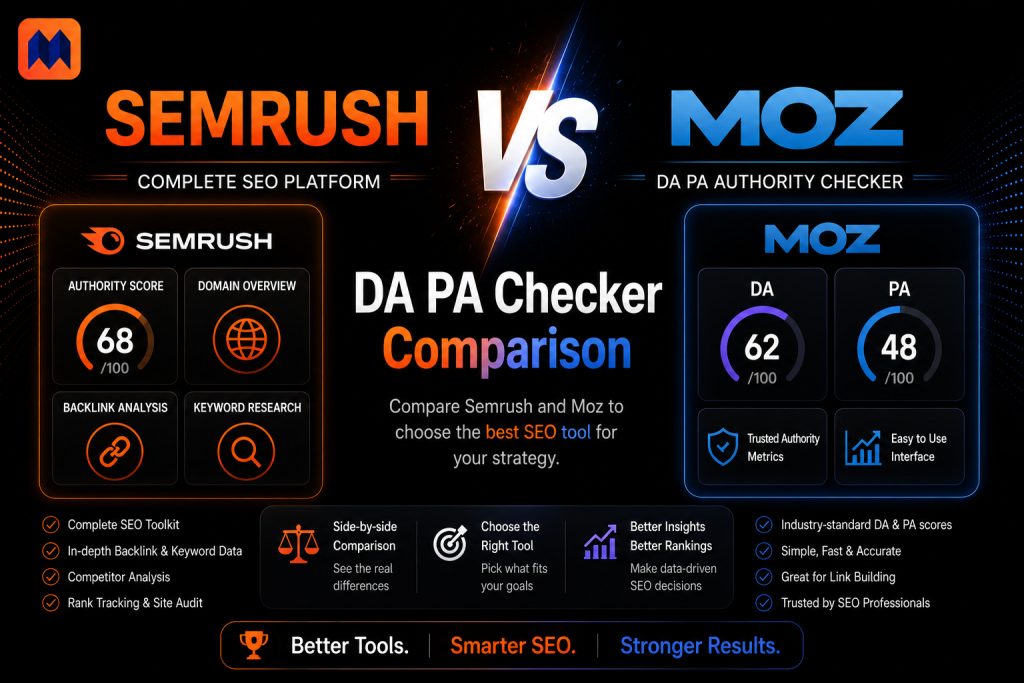
What Moz DA/PA and Semrush Authority Score Actually Measure
The gap between these two tools starts at the core: what they define as authority.
Moz Domain Authority (DA) and Page Authority (PA)
Moz introduced DA back in 2004 as the first widely used domain scoring system. The goal was to predict how likely a website is to rank in Google, using backlinks as the primary signal.
DA runs from 0 to 100 on a logarithmic scale — gains slow down significantly as you climb. Moz feeds backlink data into a machine learning model trained on actual Google search results. The key inputs: unique referring domains, quality of those linking domains, and link profile distribution. Moz keeps the full formula private.
Page Authority (PA) applies the same model to a single URL instead of the whole domain. A site at DA 45 can have inner pages anywhere from PA 10 to PA 60 depending on which pages have earned direct backlinks. PA is the metric that matters most when evaluating a specific link placement.
Moz also gives you Spam Score alongside DA and PA. It flags what percentage of spam-like signals a domain shares with sites Google has penalized — something Semrush folds into its calculation rather than surfacing separately.
Semrush Authority Score (AS)
Semrush launched Authority Score as a direct response to the manipulation problem that had infected DA and DR. AS is not a backlink-only metric. Three signals go into it:
- Backlink strength — volume and quality of referring domains, similar to what DA measures
- Organic traffic signals — estimated monthly organic visitors, which confirms the domain actually ranks for real keywords
- Toxicity / spam signals — patterns associated with link manipulation, spam networks, and penalized behavior
That traffic component changes everything. A site can manufacture backlinks and push DA to 60. It cannot manufacture real organic traffic at scale without Google actually ranking its pages. Semrush AS catches high-DA, zero-traffic sites that DA misses entirely.
AS updates every two weeks, compared to Moz’s monthly cycle. Semrush also has one of the largest backlink indexes available, updating frequently with new link discoveries.
Semrush vs Moz DA PA — Full Side-by-Side Comparison
Here’s every factor that matters when you’re deciding which tool to rely on:
| Factor | Moz DA / PA | Semrush Authority Score |
| Primary metric | Domain Authority (DA) + Page Authority (PA) | Authority Score (AS) — single unified metric |
| What it measures | Backlink profile strength via ML model (links-focused) | Backlinks + organic traffic + spam signals combined |
| Scale | 0 – 100 logarithmic | 0 – 100 |
| Update frequency | Monthly (~once every 30 days) | Every 2 weeks |
| Spam detection | Spam Score — separate % signal | Built into AS calculation (toxicity signals) |
| Traffic signals | None — backlinks only | Yes — organic traffic is a core input |
| Manipulation risk | High — DA 50+ inflated for under $100 in research | Very hard — no known reliable inflation method |
| Page-level metric | Page Authority (PA) — separate score | No dedicated page-level metric |
| Backlink index size | ~44.8 trillion links (2025) | One of the largest indexes, updated frequently |
| Free access | MozBar + free checker (limited queries/day) | Semrush free plan (limited domain lookups) |
| Paid plan starts at | ~$99/month (Moz Pro) | ~$139.95/month (Semrush Pro) |
| Best use case | Page-level PA checks, Spam Score vetting, free checks | Full authority picture, manipulation-resistant scoring |
The most important row in that table: manipulation risk. Research published in 2024 tested five new domains with contracted “authority hackers.” DA was pushed to 50+ on all five for under $100. Nobody in the experiment could reliably inflate Semrush AS — not even for a 20-point boost from zero.
That’s not a small gap in reliability. When link sellers list sites by DA, that number is genuinely easy to fabricate. When you cross-check with AS and see a site with DA 55 scoring AS 12, the site almost certainly bought its way to that DA.
Where Moz DA and PA Have a Clear Edge
Semrush AS doesn’t replace Moz across every use case. Moz still leads in several specific areas.
Page Authority — No Semrush Equivalent
Semrush doesn’t publish a page-level authority metric. Moz PA is the only mainstream score that tells you how much authority a specific URL carries based on its own backlink profile.
This matters constantly during outreach. You want a link from a specific resource page on a high-DA site. That page’s PA could be 15 or 55 — two completely different link values. Without PA, you’re guessing.
Spam Score — Explicit Risk Flagging
Moz surfaces Spam Score as a separate visible percentage. You see exactly how much risk a domain carries based on signals associated with penalized sites. Semrush folds toxicity detection into AS without showing you the underlying flag.
For quick outreach vetting, seeing a Spam Score of 72% on a DA 40 site immediately tells you something is wrong. With Semrush, you’d need to dig into the Backlink Audit tool to find the same information.
Free Access and Industry Recognition
Moz’s free tools are genuinely useful without a paid plan. MozBar shows DA as you browse. The free domain checker handles basic lookups without login. Semrush’s free tier is more limited, and meaningful AS access requires a paid subscription.
DA is also the most widely recognized authority metric in link building outreach. Guest post editors know what DA means. Many set minimum DA thresholds in their submission guidelines. AS is gaining ground but DA still dominates the conversation in link acquisition negotiations.
Where Semrush Authority Score Has the Edge
For serious SEO work, AS is harder to fool and more informative in most situations.
Manipulation Resistance — The Critical Difference
DA’s backlink-only model makes it directly manipulable. Buy referring domains from a link farm, and DA climbs. Google penalizes the site, and DA stays the same or even rises. This is well-documented behavior.
Semrush AS has no documented reliable inflation method. The organic traffic requirement means a site has to actually rank for something in Google before AS reflects strength. Fake backlinks don’t generate real rankings. Real rankings don’t come from fake backlinks at scale.
When Semrush spots a domain with lots of backlinks and zero organic traffic, AS stays low. That single behavior prevents the most common form of metric manipulation in the link selling market.
More Frequent Updates
AS updates every two weeks. DA updates monthly. During active outreach campaigns or after significant link acquisitions, AS reflects changes twice as fast.
For agencies tracking client authority growth, two-week cycles give you more data points per quarter than monthly updates. Trends become visible faster.
Holistic Authority Picture
A site with DA 50 tells you about its backlinks. A site with AS 50 tells you it has strong backlinks and real organic traffic and a clean link profile. AS is a fuller picture by design.
When evaluating whether a site is genuinely authoritative — not just whether it has accumulated links — AS answers the question DA cannot.
How to Interpret Moz DA and Semrush AS Scores
Both tools use a 0–100 scale, but the numbers don’t mean the same thing at each level. Here’s a practical reference:
| Score | Moz DA Interpretation | Semrush AS Interpretation |
| 0 – 20 | New or very thin site. Avoid for link building. | New or very thin site. Low organic presence. |
| 20 – 40 | Reasonable for niche sites. Check Spam Score before outreach. | Moderate authority. Some organic traffic signals. |
| 40 – 60 | Solid target. Established domain in most niches. | Good authority. Real traffic contribution visible. |
| 60 – 80 | High authority. Competitive niche leaders. | Strong domain. Traffic and links both verified. |
| 80+ | Elite domains (news, government, major brands). | Dominant authority. Hard to reach this range. |
One pattern to watch: DA 40–60 is where the manipulation problem is most concentrated. Link sellers target this range because it looks credible without requiring massive investment. A DA 45 site with AS 8 is almost certainly a site with purchased links and no real organic presence. A DA 45 site with AS 38 is a genuinely solid domain.
Which Tool to Use — Task by Task
You don’t need to choose one permanently. Each tool earns its place depending on what you’re doing:
| Task | Use This | Why |
| Quick outreach prospect check | Moz DA + Spam Score | Free tools, fast check, spam signal included |
| Deep competitor authority audit | Semrush AS | Traffic-verified scores resist manipulation |
| Page-level link equity check | Moz PA | Semrush has no equivalent page-level metric |
| Domain purchase / expired domain buy | Both AS + DA | Cross-check to detect inflated-but-dead sites |
| Reporting to clients on link value | Moz DA | DA is the most widely recognized metric in pitches |
| Identifying fake authority sites | Semrush AS | Zero-traffic sites drop in AS even with high DA |
| Backlink audit for toxic links | Moz Spam Score + AS | Moz flags link-level spam; AS flags domain health |
| Budget-conscious freelance research | Moz DA (free tools) | MozBar and free checker work without paid plan |
The pattern is consistent. Moz leads when you need free access, page-level data, or an explicit spam flag. Semrush leads when you need manipulation-resistant scores or a fuller picture of a domain’s real authority.
For high-stakes decisions — domain purchases, expensive link placements, partnership evaluation — run both. A site that scores well on Moz but shows a very low AS is flagging something. Worth investigating before you commit.
What Neither Tool Gets Right
Both Moz and Semrush make the same fundamental promise: this score predicts SEO performance. Both overstate it.
Google doesn’t use DA or AS in its algorithm. John Mueller confirmed this multiple times. Rankings come from content relevance, technical SEO health, user experience, and real backlink quality — not from what a third-party tool calculates.
What neither metric tells you:
- Whether a site’s content matches your target audience’s search intent
- Technical health — crawlability, Core Web Vitals, page speed, indexing status
- Whether a link from this domain will actually pass PageRank to your page
- Real domain trust as Google defines it internally
High DA and high AS correlate with ranking because sites that rank tend to earn strong links and traffic. Correlation is not causation. A DA 20 site with better content outranks a DA 55 site with thin content every day.
Use both scores as filters to narrow your focus, not verdicts to base final decisions on. Always look at the actual site. Read the content. Check what it ranks for. The score is the starting point, not the end point.
Conclusion on Semrush vs Moz DA PA Checker
Moz DA and Semrush AS aren’t competing products doing the same thing. They’re different tools answering different questions about the same website.
DA is the standard for page-level analysis and free access. Spam Score is its most underused advantage. AS is the more reliable signal when you need to know whether a site’s authority is real or purchased — no inflation method exists for it that doesn’t require actual SEO work.
Use Moz when you need PA, Spam Score, or free daily checks. Use Semrush when the stakes are high enough that you need a manipulation-resistant score. Use both when you’re making a decision that costs real money or real time. And after checking the scores, open the actual site. Numbers narrow the list. Your eyes close the deal
Frequently Asked Questions
Why does the same site show a much higher DA than Semrush AS?
Because they measure different things. DA counts backlinks and link quality through a machine learning model. Semrush AS adds organic traffic and toxicity signals on top. A site can accumulate referring domains through link buying — pushing DA up — without generating real organic traffic. AS stays low because the traffic signal fails. That gap between DA and AS is often the clearest indicator that a site’s authority isn’t genuine.
Is Semrush Authority Score more accurate than Moz DA?
More accurate for what? For detecting manipulated authority, AS is clearly more reliable — no documented method exists for inflating it without doing real SEO work. For page-level authority, DA is more precise because Semrush has no equivalent to Page Authority. For general site comparison, AS gives a fuller picture. For industry recognition in outreach negotiations, DA is still the standard. ‘Accurate’ depends on the question you’re asking.
Can I use both Moz and Semrush together?
Yes — and for important decisions, you should. Run DA and PA through Moz to check backlink strength and Spam Score. Run AS through Semrush to verify that organic traffic backs up the authority. A site with strong scores on both tools is a genuinely solid prospect. A site with high DA and very low AS is almost certainly manipulated. Cross-referencing takes an extra minute and saves you from expensive mistakes.
Does Semrush offer a PA equivalent?
No. Semrush Authority Score is a domain-level metric only. There is no Semrush equivalent to Moz’s Page Authority. If you need to evaluate the link equity of a specific page rather than the whole domain, Moz PA or Ahrefs URL Rating (UR) are the tools for that job. This is the one area where Moz fills a gap Semrush doesn’t cover.
How often do Moz DA and Semrush AS update?
Moz updates DA approximately once per month. Semrush updates AS every two weeks. Neither is real-time. If you built backlinks last week, expect Semrush to reflect them before Moz does. Ahrefs DR updates every 12–24 hours, which makes it the fastest option if campaign tracking speed matters.
Which tool is better for link building outreach?
Moz DA for initial filtering — it’s the metric most site owners and guest post editors recognize and use in their own minimum thresholds. Semrush AS for verification before committing to a link purchase or significant outreach investment. Running both gives you a filter that catches most manipulated sites before you waste time or money on them.
Are there free tools that show both Moz DA and Semrush AS?
Yes. SEO Review Tools built by Kris Bogaerts shows both DA and AS in a single lookup without requiring paid subscriptions to either platform. This makes it practical for checking multiple metrics without switching between tools or managing two paid accounts. For bulk checking across hundreds of domains, paid API access from either provider becomes necessary.

Writes about SEO, link building and domain authority.