
In short, don’t worry too much about Domain Authority (DA) just because it’s there. Domain Authority is great for comparing your entire authority (mostly your total link equity) to that of other sites and figuring out where you can compete. Get actual links that bring in visitors, and your Domain Authority and rankings will both go up.
If you haven’t been living under a rock, over a rock, or really anywhere near a rock, you probably know that Moz has put a lot of effort, study, and money into a new-and-improved Domain Authority. People that utilize Domain Authority (DA) naturally want to raise their score. This is a topic we’ve avoided at times since, like any metric, DA can be misused if it’s not looked at in context or on its own.
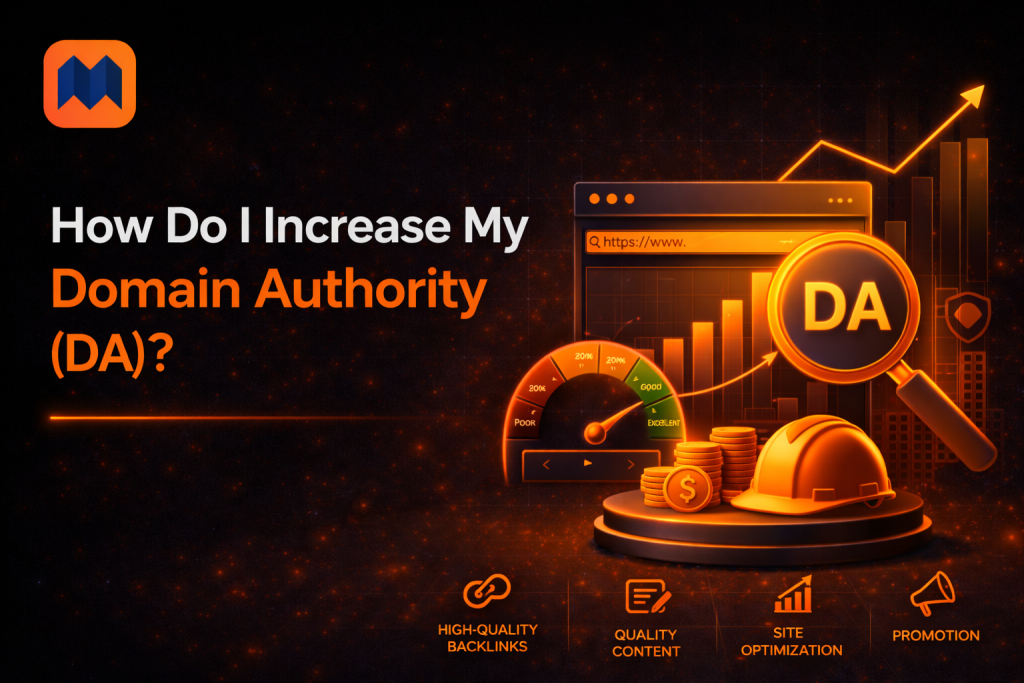
Why & how do i increase my Domain Authority?
It may sound strange that I’m asking you this question since I work for the company that created Domain Authority, but it’s the most important one I can ask you. What do you want to do? Domain Authority is a way to measure how well you’re doing (more on that in a minute), but it doesn’t indicate you’re successful. DA doesn’t effect your rankings directly since Google doesn’t use it. Trying to boost your DA only for the sake of increasing it is useless.
So, I don’t want a high DA?
I see why you’re confused. If I were to make Domain Authority too simple, I would say that it shows how much link equity you have overall. Yes, a high DA is preferable than a low DA, everything else being equal. It’s OK to want a higher DA, but it shouldn’t be your only aim.
So, DA is useless, then?
No, but you shouldn’t use it carelessly or out of context, just like any other measure. Our Domain Authority resource site goes into more depth, but the simple answer is that DA is a great way to figure out how competitive you are. Smart SEO isn’t about wasting resources on keywords that don’t matter; it’s about knowing where you can genuinely compete. It doesn’t help to know that your DA is 48 if you don’t know anything else.
If you know that your DA is 48 and the sites that are competing for a query you want to rank for have DAs between 30 and 45, it may be quite helpful. Also, knowing that your potential rivals have DAs of 80 or more might save you a lot of time and money.
But Google says DA isn’t real!
This is a blog article (or eleven) on its own, but I’m going to make it shorter by just writing a few points. First, Google’s official pronouncements tend to use highly specific definitions. Google has indicated that they don’t employ a measure for domain-level authority to rank sites. All well, let’s accept it at face value. Do you think that a new page on a low-authority domain (DA = 25) has the same probability of ranking as a high-authority domain (DA = 75)? No, since a domain’s overall internal link equity is based on the links to its individual pages. It still exists, even if you don’t assess that overall influence in a single way.
Let me ask you something else. How can you tell how competitive a new page is if it doesn’t have any Page Authority (or PageRank or any other metrics that Google uses)? This question is a significant part of why Domain Authority exists: to assist you figure out how well you can compete on keywords you haven’t targeted yet and for content you haven’t even produced yet.
Seriously, give me some tips!
I trust that you took all of my warnings seriously. You should try to raise your Domain Authority since it’s the best authority measure you have, and authority is usually a positive thing. There are no hidden tricks to making the things that affect DA better, but these are the basic ones:
1. Get more high-authority links
I realize that’s shocking, but that’s all there is to it. Links from pages and sites with a lot of authority still have a lot of ranking power. They also boost both Domain Authority and Page Authority. You know that high-authority connections are excellent to have, even if you don’t care about DA. There are thousands of postings and more than a few full-length books on how to get them (well, okay, books—there’s definitely a novel and a feature film in the works).
2. Get fewer spammy links
Google definitely attempts to minimize poor links, and our new DA score does a far better job of this. Keep in mind that “bad” doesn’t signify links with low authority. It’s normal to have some links from sites and domains with low authority. In many circumstances, these connections are both relevant and helpful to searchers. Moz’s Spam Score is quite complicated, but we all recognize when we’re going after links that aren’t really good or relevant. Stop it.
3. Get more traffic-driving links
Our new DA/PA Checker score now takes into account whether links originate from actual sites with real traffic, as it’s a strong evidence that they are helpful. You may not utilize DA every day, but you know that getting links that bring in traffic is a positive thing that shows you’re relevant to searches and helps your bottom line. It’s also an excellent excuse to avoid going after every connection you can find. What good is a link that no one will notice, that doesn’t bring in any traffic, and that both our authority metrics and Google are likely to ignore?
You can’t fake real authority
It’s feasible to change Domain Authority, just like any other measure that relies on signals we can’t control. The question is: why? Please, for the love of God, stop selling DA 10 links for $1, DA 20 links for $2, and DA 30 links for $3. I’ve seen it nearly exactly in a lot of email pitches. Please don’t purchase those links. Instead, use that money to buy something helpful, like sandwiches.
Put in the time and effort to create actual authority that will help both Moz metrics and Google. It’s difficult at first, but the benefits will last for years. Use Domain Authority to find out where you can compete now, at a low cost, and get the most out of your investments. Don’t let it turn into just another useless number.

Writes about SEO, link building and domain authority.