DA PA Checker for Backlink Analysis — How to Do It Right
Your site has hundreds of backlinks. Some are working. Some are dead weight. A handful might be actively hurting you. The problem is you can’t tell which is which just by looking at a list of URLs.
Checking links one at a time doesn’t scale. You need a process that runs the whole list and hands you back something you can actually act on.
This guide covers the full process: exporting your backlinks, running them through a checker, reading what you get back, spotting toxic links, and finding opportunities your competitors are sitting on that you aren’t.
Why DA and PA Matter for Backlink Analysis
Links are not equal. A backlink from a DA 5 blog with 80% Spam Score helps nobody. A link from a clean DA 60 site in your exact niche is genuinely valuable. The hard part is knowing which is which — across a list of hundreds — without spending a week doing it manually.
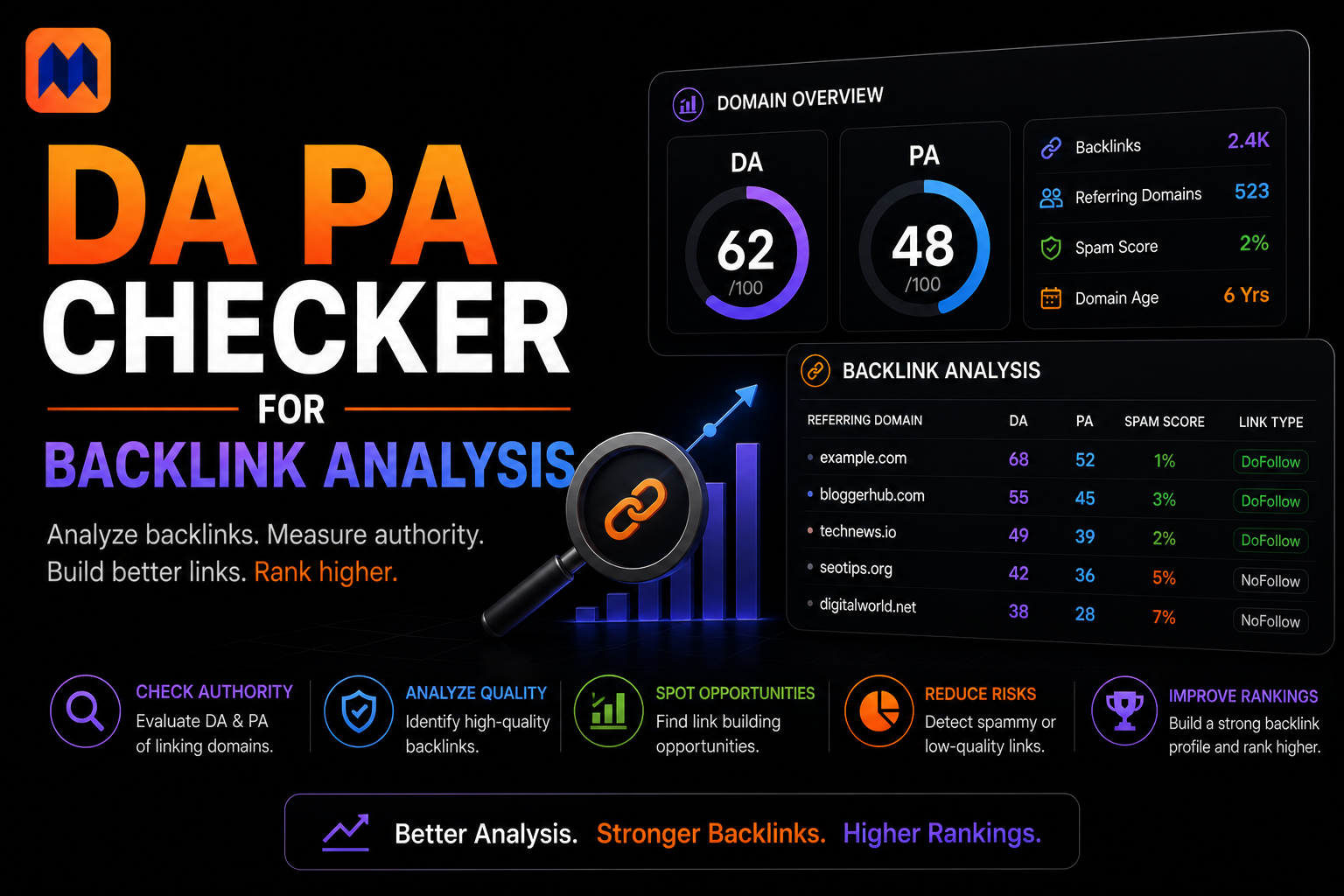
A DA PA checker cuts through that in minutes. It returns three signals for every domain on your list:
- DA (Domain Authority) — how strong the linking domain is overall
- PA (Page Authority) — how much authority the specific linking page carries
- Spam Score — how closely the linking domain resembles sites that Google has penalized
Used together, these three numbers let you sort 400 backlinks into tiers in about an hour. Without them, you’re guessing at link quality based on how a site looks — which is exactly how people end up with toxic backlink profiles they didn’t know about.
Good links lift you. Bad links drag you down. The whole point of backlink analysis is knowing which is which before rankings tell you the hard way.
What a DA PA Checker Shows You During Backlink Analysis
A solid DA PA checker returns six data points per domain. Here’s what each one actually tells you when you’re working through a backlink list:
| Metric | What It Measures | Question It Answers |
| DA (Domain Authority) | Strength of the linking domain | Is this domain worth having a link from? |
| PA (Page Authority) | Strength of the specific linking page | How much authority does this exact page pass? |
| Spam Score | Risk level based on spam patterns | Should I disavow or avoid this link? |
| Total Backlinks | Raw link volume to the domain | Is this site accumulating links naturally? |
| Quality Backlinks (QB) | Dofollow backlinks only | How many of these links actually pass equity? |
| Referring Domains | Unique domains linking in | Is the link profile diverse or concentrated? |
Most people look at total backlinks and stop. That’s a mistake. Total backlinks includes nofollow links that pass zero SEO value. The quality backlinks column shows only dofollow links — the ones that actually move the needle. A site with 1,000 total backlinks and 50 quality links is completely different from one with 400 total and 380 quality.
Link diversity matters as much as volume. Two hundred links from three domains is a much weaker profile than sixty links from sixty different domains. The referring domains count in your checker output shows you how spread or concentrated your profile is — and concentrated profiles are fragile.
The Backlink Analysis Workflow — Step by Step
Follow these steps in order. By the end you’ll have a tiered, actionable picture of every link pointing at your site:
| Stage | Action | What to Do |
| Step 1 | Export your backlinks | Pull your full backlink list from Moz Link Explorer, Ahrefs, or Semrush — export as CSV |
| Step 2 | Bulk-check DA + Spam Score | Paste all linking domains into a bulk DA PA checker and run in one go |
| Step 3 | Filter by DA minimum | Sort by DA and cut anything below your niche minimum threshold |
| Step 4 | Flag high Spam Score links | Flag every domain above 40% Spam Score as a disavowal candidate |
| Step 5 | Check PA on linking page | Check PA on the actual linking page — domain DA alone doesn’t tell the full story |
| Step 6 | Cross-check traffic | Verify organic traffic on remaining domains — DA can be bought, traffic can’t |
| Step 7 | Disavow or outreach | Disavow the worst offenders; do outreach on lost or broken links you want back |
| Step 8 | Monitor monthly | Repeat monthly — profiles shift and new toxic links appear without warning |
Step 6 is where most guides tap out. DA is manipulable — buying bulk referring domains is a documented market. A site with DA 45 and near-zero organic traffic almost certainly bought that score. A link from that domain passes little real authority regardless of what the number says. Checking traffic catches those cases before they corrupt your analysis.
How to Identify Toxic Backlinks Using DA and Spam Score
A toxic backlink sits in a bad neighborhood. It associates your domain with penalized or low-quality sites, and Google notices that association. Finding them before they cost you rankings is the core use case for a DA PA checker.
The Spam Score Threshold
Spam Score runs from 1% to 100% and measures how closely a domain matches patterns Moz has identified among penalized sites. Here’s how practitioners read the ranges:
- 0–20% — Low risk. Links from these domains are generally fine to keep.
- 21–40% — Moderate risk. Worth a manual look before deciding either way.
- 41–60% — High risk. Investigate these. Most will end up in your disavowal file.
- 61–100% — Very high risk. Disavow unless manual review gives you a specific reason not to.
High Spam Score doesn’t automatically mean toxic. New domains, sites in historically suspicious niches, and sites with unusual link patterns can all score high without being genuinely harmful. Always manually open the site before pulling the disavowal trigger.
Combining DA and Spam Score for Accurate Filtering
The clearest toxic signal is low DA paired with high Spam Score. A DA 8 domain at 75% Spam Score pointing at your site is almost certainly junk — remove or disavow it.
High DA with high Spam Score is harder to read. Some legitimate sites accumulate messy link profiles over years without getting penalized. Check whether the site ranks for keywords and pulls real traffic. A DA 40 site at 55% Spam Score might just have a history of accepting any backlink that came its way — not the same as being genuinely toxic.
Links That Are Toxic Regardless of Spam Score
Some links look toxic without triggering a high Spam Score. Watch for these patterns:
- Sites where all content is in a foreign language completely unrelated to your niche
- Identical anchor text repeated across dozens or hundreds of different domains
- Site-wide footer or sidebar links on directory-style sites with thin content
- Private blog network (PBN) links — recognizable by thin content, fake or absent authorship
Backlink Quality Scoring — How to Tier Your Link Profile
With DA, Spam Score, and PA in hand, sort your links into tiers. You’ll spend far less time in manual review if you let the numbers narrow the list first:
| Linking Domain DA | Spam Score | PA of Linking Page | Traffic Signal | Action |
| DA 60+ | Below 10% | Below 10% | Genuine traffic | Priority target |
| DA 40–59 | 10–25% | 10–20% | Solid traffic | Strong target |
| DA 25–39 | Below 20% | 15–25% | Some traffic | Worth pursuing |
| DA 20–35 | 25–40% | Any | Minimal traffic | Manual review needed |
| Any DA | Above 50% | Any | Any | Skip — red flag |
Apply this grid to your full backlink export. Priority and Strong rows are links worth protecting and building on. Skip rows go straight to the disavowal list. Review rows get a manual pass — five minutes each, open the site, read the content, check who else links to it.
Using a DA PA Checker for Competitor Backlink Analysis
Your own profile tells you where you stand. Your competitor’s profile tells you where you’re missing out. Run their backlinks through the same checker and you get a ready-made prospecting list.
Finding Competitor Link Sources
Pull your competitor’s full backlink export from Moz, Ahrefs, or Semrush. Drop all the linking domains into a bulk DA PA checker and run them in one batch.
Sort by DA highest to lowest. You’re hunting for high-DA, low Spam Score domains that link to your competitor but haven’t linked to you yet. Each of those rows is an outreach target.
The reasoning holds: if a DA 55 site with clean spam signals published content linking to your competitor, they’re already the kind of site that links to players in your space. Reach out with something better or complementary and you have a real chance.
Link Gap Analysis in Practice
A link gap is any domain linking to your competitors but not to you. These are the best outreach targets you’ll find — the site has already shown it links to your niche, so you’re not starting from zero.
Here’s how to find them:
1. Export backlinks for your top 3 competitors
2. Combine the lists and remove duplicates
3. Run the combined domain list through a bulk DA PA checker
4. Filter for DA 30+ and Spam Score under 25%
5. Cross-reference against your own backlink list
6. Anything remaining that doesn’t link to your site is a gap worth closing
This produces better outreach lists than any cold prospecting method. You’re not pitching blind — you’re approaching sites that have already proven they link to your category.
How to Track Backlink Quality Changes Over Time
A single audit is a snapshot. The trend is what matters. Running monthly DA PA checks on your backlinks shows you whether you’re building authority, losing it, or picking up risk without realizing it.
What to Track Monthly
Keep a spreadsheet with these columns and update them every month:
- Average DA of all linking domains — rising average means better links are coming in
- Count of linking domains above 40% Spam Score — a rising number is an early warning
- Total quality backlinks (dofollow only) — this is the number that actually reflects your equity
- Unique referring domains — spread matters as much as raw count
- Links gained vs lost — net movement tells you the real trajectory of your profile
A sudden spike in low-DA links is an early warning sign. It often precedes a manual action or an algorithmic hit by weeks. Catching it in a monthly check gives you time to disavow before any damage shows up in rankings.
When to Run an Emergency Audit
Monthly is the standard cadence. Don’t wait for it if you see any of these:
- Rankings drop 5+ positions across multiple keywords at once
- A manual action lands in Google Search Console
- Referring domains spike without any outreach on your end
- Your Spam Score climbs noticeably between scheduled checks
Any of these means run the full check now. Waiting for the monthly schedule lets a problem compound for weeks before you see it.
Mistakes That Ruin a Backlink Analysis
These mistakes come from getting the data right but reading it wrong.
Judging Links by DA Alone
DA is the first filter. It’s not the verdict. A DA 50 site at 70% Spam Score is a worse link source than a DA 28 site at 5% Spam Score. Spam Score has to be part of every link quality call.
Checking Domain DA Instead of Page PA
Your link comes from a page, not from a domain. A DA 50 site with PA 11 on the inner page carrying your link is weaker than the domain score implies. Always check the PA of the actual linking URL.
Mass Disavowing Without Manual Review
Disavow is blunt and hard to undo cleanly. Bulk-disavowing on Spam Score alone will take legitimate links with it. Manually open the top candidates before submitting anything to Google.
Ignoring Nofollow vs Dofollow Distinction
Nofollow links pass nothing. A site with 500 total backlinks and 450 nofollow has a weak profile regardless of what the count looks like. Use the quality backlinks column — dofollow only — as your actual equity number.
Skipping Competitor Analysis
Your own audit shows the current state. Competitor analysis shows the opportunity. Running only your own links through the checker skips the part that actually drives link building action.
Conclusion on DA PA Checker for Backlink Analysis
A DA PA checker turns a raw backlink list into a ranked action plan. DA shows domain strength. PA shows how much the linking page is actually worth. Spam Score shows which links are working against you.
Run the full process: export your links, bulk-check the domains, tier by quality, flag toxics, verify traffic, compare against competitors. Monthly. That cadence catches problems before rankings do.
Sites that rank consistently don’t have the most backlinks. They have the cleanest ones, the strongest ones, and a routine that catches bad links early. A DA PA checker makes that routine possible without turning it into a full-time job.