Domain Age vs DA PA — Why Domain Age Matters for SEO
You register a new domain. Your DA is 1. Competitors with 5-year-old sites sit at DA 40. You wonder whether you’re fighting a losing battle from day one.
Domain age gets blamed for a lot. Some say it’s everything. Others say Google doesn’t care at all. The truth sits somewhere in between — and misunderstanding it costs time and money.
This guide explains exactly how domain age connects to DA and PA, what Google actually uses, and what you can do about it regardless of how old your domain is.
What Domain Age Actually Means
Domain age has two different definitions, and the distinction matters more than most people realize.
Registered age is simply how long ago the domain was first purchased. A domain bought in 2018 is seven years old in 2025 regardless of what happened to it since.
Active age is how long the domain has had real content indexed by Google. A domain could have been registered in 2015 but sat parked with no content until 2022. Google cares about the active age far more than the registration date.
Google’s own documentation makes this explicit: they start counting from when they first discovered and crawled the domain, not from the registration date. A domain that was registered early but inactive for years may be treated as newer than it appears.
This distinction trips up a lot of people buying aged domains. The registration date in WHOIS data looks impressive. But if the site sat dormant or changed niches multiple times, Google effectively treats it as a fresh domain.
What Google Actually Says About Domain Age
John Mueller, Google’s Search Advocate, has stated directly that domain age provides zero SEO benefit. Google confirmed that domain age alone is not a ranking factor. Full stop.
But that’s not the complete picture. A 2024 data leak from Google’s internal systems revealed that Google uses an attribute called hostAge to determine which new sites to sandbox. This confirmed something SEOs had suspected for years but couldn’t prove.
So the reality looks like this:
• Domain age is not a positive ranking factor — having an older domain doesn’t directly boost rankings
• Domain age does influence the sandbox filter — newer domains face a scrutiny period that older domains don’t
• Age correlates with the signals Google does care about — backlinks, indexed content, user trust
The sandbox effect is the practical impact most new site owners feel. It’s not that Google penalizes new domains. It’s that new domains haven’t earned the trust signals yet to bypass tighter content scrutiny. Time is part of that trust-building, but it’s not the only part.
Older domains rank better on average because they’ve had more time to earn backlinks, publish content, and build audience trust — not because Google rewards age itself.
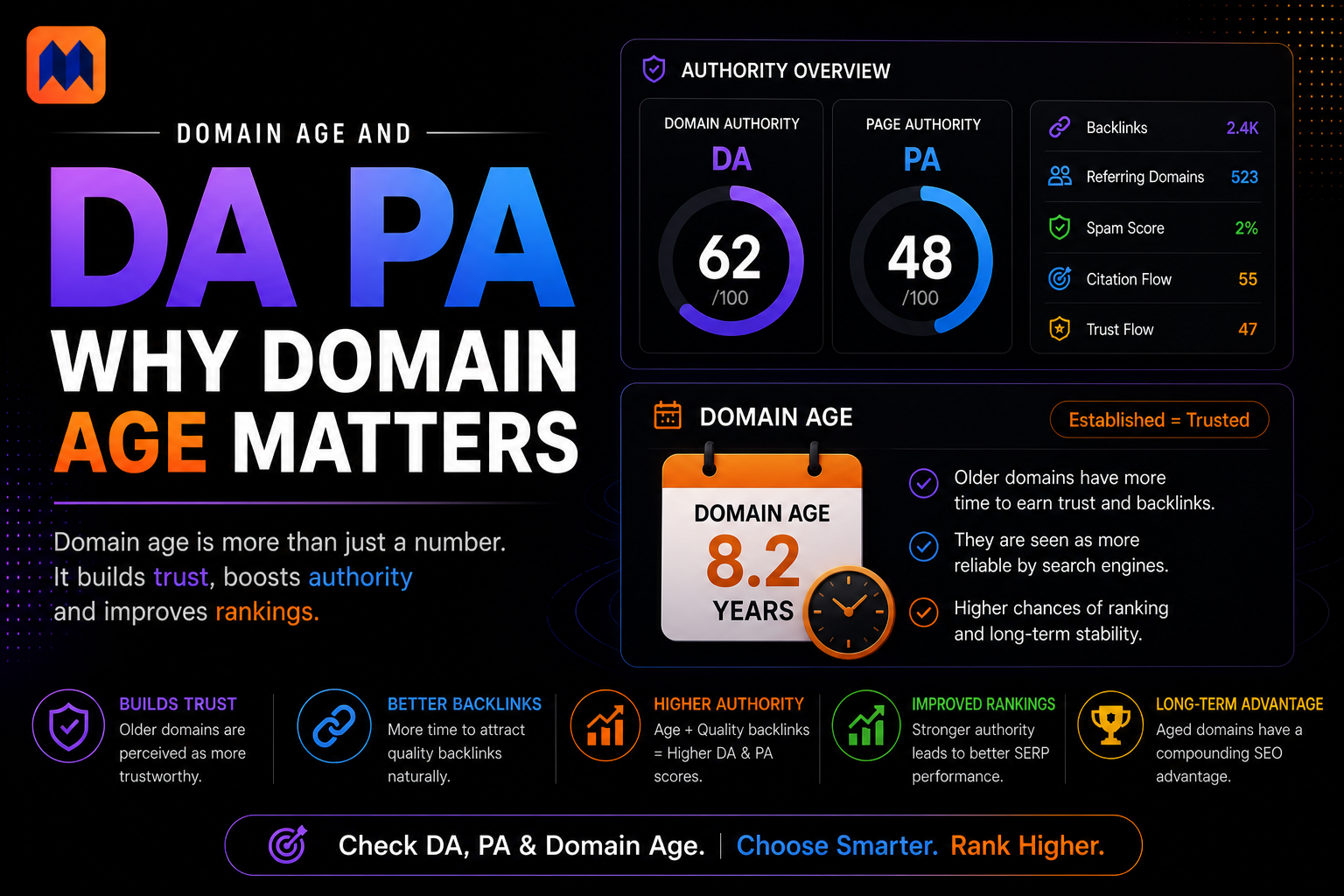
How Domain Age Connects to DA and PA Scores
DA and PA are Moz metrics & you can check it by using our tool, not Google ranking factors. But the way they’re calculated makes domain age indirectly relevant.
DA is calculated primarily from the backlink profile. The more referring domains pointing at your site, and the stronger those domains are, the higher your DA climbs. Older domains simply have had more time to accumulate those links.
A domain launched in 2018 that published consistently and earned links naturally will typically sit at a much higher DA than one launched in 2023 following the same strategy. Not because Moz rewards age, but because seven years of link accumulation beats two years of the same effort.
How Age Affects DA Growth Speed
The relationship between age and DA isn’t linear. Here’s what the typical progression looks like for sites that are actively building links and publishing content:
| Domain Age | Typical DA Range | What to Expect |
| Under 1 year | DA 1–15 typical | Still in sandbox territory for most niches. Focus on content and first backlinks. |
| 1–3 years | DA 10–30 typical | Building phase. DA grows if you’ve been consistently earning backlinks. |
| 3–6 years | DA 20–45 typical | Established. Strong content history and link profile start compounding. |
| 6–10 years | DA 35–60 typical | Mature domain. DA reflects years of accumulated link equity. |
| 10+ years | DA 50–80+ possible | Elite territory. Usually reserved for major brands and authority publishers. |
These ranges are approximations across many niches. In competitive verticals like finance, healthcare, or SaaS, every tier sits higher. In lower-competition niches, a three-year-old site might already be one of the strongest in its space at DA 30.
The key takeaway: DA growth is slow in the first year regardless of what you do. The link profile needs time to diversify. Moz’s algorithm requires a broad spread of unique referring domains before DA moves meaningfully. This is why trying to rush DA in year one through link buying rarely works the way people expect.
New Domain vs Aged Domain — What the Data Actually Shows
One of the most common questions in SEO is whether buying an aged domain gives you a meaningful head start on DA and rankings. The answer is: sometimes, but not for the reasons most people assume.
| Factor | New Domain | Aged Domain |
| DA starting point | DA 1 (no backlinks yet) | Varies — inherited link profile |
| Google sandbox risk | Higher — new sites face more scrutiny | Lower — established crawl history |
| Backlink profile | Empty — must build from scratch | Existing links (quality varies widely) |
| Content index | Nothing indexed yet | Pages indexed, some may rank already |
| DA growth speed | Slow — 6–18 months minimum | Faster if backlinks are real and clean |
| Spam history risk | None (clean slate) | Unknown — must audit before buying |
| Brand recognition | Zero | May have residual recognition |
| Cost | Low — standard registration fee | Premium — aged domains sell at markup |
The sandbox risk column is worth dwelling on. New domains face a period where Google scrutinizes content more carefully before granting competitive rankings. This period varies — some sites push through it in 3–4 months, others take 12–18 months depending on niche competitiveness and content quality.
An aged domain skips this scrutiny, but only if its history is clean. A domain that was previously used for spam, abandoned for years, or had its niche changed multiple times gets reassigned a new trust level by Google. Buying an aged domain with a dirty history can be worse than starting fresh.
How to Check an Aged Domain Before Buying
If you’re considering an aged or expired domain for the authority head start, the due diligence process matters as much as the purchase. Here’s exactly what to check:
| Check | Tool | What You’re Looking For |
| Check Spam Score | Moz DA PA Checker | Above 40% is a warning. Above 60% is usually a skip. |
| Audit backlink profile | Moz / Ahrefs / Semrush | Look for spammy links, link farms, unrelated niches |
| Check Google index | site: operator in Google | If most pages aren’t indexed, the domain may be penalized |
| Review domain history | Wayback Machine | Check what the site published before. Niche changes hurt authority. |
| Verify organic traffic | Semrush / Ahrefs | High DA with zero traffic = likely inflated or penalized |
| Check for manual actions | Google Search Console | Only possible if you verify domain ownership first |
| Review anchor text profile | Moz Link Explorer | Over-optimized exact-match anchors signal past manipulation |
| Compare DA to traffic | Cross-check both tools | DA 40 with 200 monthly visitors is a major mismatch |
The Wayback Machine check is the one most buyers skip. Go to web.archive.org, enter the domain, and look at snapshots from the last 5–10 years. If the site was previously in a completely different niche, or if there’s a long gap in the archive with no captures, that’s a signal worth investigating.
Google also takes niche changes seriously. A domain that spent five years as a cooking blog and was then redirected to a tech site doesn’t carry its cooking authority into the new niche. The link equity transferred, but the topical trust didn’t. DA scores can look healthy while topical relevance is essentially zero.
How to Grow DA on a New Domain Without Waiting Years
Domain age is slow. Backlinks are fast, relatively speaking. Since DA responds to links rather than time directly, the best strategy for a new domain is aggressive but clean link building from day one.
Build Referring Domain Diversity Early
DA responds to unique referring domains more than to raw link count. Getting 50 links from 5 domains does less than getting 20 links from 20 different domains. Focus your early outreach on breadth, not depth.
Guest posting, digital PR, resource link building, and niche directory submissions all help diversify your referring domain count. Start this in month one, not month six.
Earn Links to Inner Pages, Not Just the Homepage
PA is a page-level metric. A site where only the homepage earns backlinks will have a strong PA on that page and weak PA everywhere else. Spread link building across your most important service pages and content pieces.
When a specific inner page earns backlinks, two things happen: its PA rises directly, and the domain’s overall link diversity improves, contributing to DA growth.
Publish Content That Earns Links Naturally
Original data, detailed guides, and tools attract backlinks that you didn’t have to pitch. A study, a free calculator, or a genuinely comprehensive resource in your niche will earn links over months and years as people discover and reference it.
This is the strategy that compounds. A guest post earns you one link. A useful free tool earns you fifty links over two years without any ongoing effort.
Avoid the Sandbox Trap on New Domains
Google’s sandbox behavior on new domains tends to ease when the site consistently publishes content and earns backlinks from legitimate sources. The worst thing you can do on a new domain is buy bulk links in the first 90 days.
Sudden link spikes on new domains trigger scrutiny, not trust. Build slowly for the first 2–3 months, then accelerate once Google has established a clear crawl pattern for your domain.
Domain Age and DA When Evaluating Link Prospects
When you’re vetting sites for guest posts or backlink outreach, domain age appears in most DA PA checkers alongside the authority scores. Here’s how to read it practically.
Older Domain + High DA + Low Spam Score
This is the gold standard link prospect. The site has had time to earn real links, hasn’t been penalized, and its DA reflects genuine authority. Prioritize these.
Newer Domain + Rising DA + Low Spam Score
A site that’s 2–3 years old with rising DA and clean spam signals is often a better link partner than you’d expect. It’s actively building authority, has a real audience, and the link it passes now will be worth more as the site matures.
Old Domain + High DA + High Spam Score
This combination is the most dangerous to misread. The site may have accumulated links over years, but many of them could be toxic. High Spam Score on an old site often means it went through a period of aggressive link buying or got sold and misused.
Always cross-check DA with Spam Score. Age and DA together don’t protect against a dirty link profile.
New Domain + Low DA + Low Spam Score
A clean new site with low DA isn’t necessarily a bad link prospect — it depends entirely on niche relevance and traffic. If the site is new but already pulling real visitors in your niche, that link will grow in value as the domain ages. Don’t dismiss it purely on DA.
Conclusion on Domain Age vs DA PA
Domain age doesn’t directly move DA or PA scores. What it does is create the conditions for those scores to grow. More time means more opportunity for backlinks to accumulate, content to get indexed, and user trust to develop.
For new domains, the honest answer is: the sandbox period is real, DA growth is slow in year one, and patience paired with consistent link building is the only legitimate path. Shortcuts — bulk links, aged domain purchases without proper vetting — create problems that cost more to fix than the time they saved.
For aged domains, the DA number matters less than what built it. A clean, topically relevant aged domain with real traffic is worth more than a high-DA site with a dirty backlink history. Use a DA PA checker with Spam Score before any significant investment in an aged domain. The numbers tell you more than the registration date ever will.