
What Is URL Rating (UR) and How Is It Different from Page Authority?
You open Ahrefs and see a URL Rating of 34 on a page. Then you check the same page in Moz and see a Page Authority of 41. Two scores, two tools, same page — and neither matches. If you’ve ever stared at this disconnect and wondered which number to trust, or what each one is actually measuring, you’re not alone.
URL Rating (UR) and Page Authority (PA) both score individual pages on a 0–100 scale. They’re both described as measures of a page’s ranking strength. And they’re both used constantly in link building, competitor research, and content strategy. But they’re calculated differently, updated at different frequencies, and built to answer different questions. Using them interchangeably leads to decisions based on incomplete information.
Here’s exactly what each metric measures, how they diverge where it matters, and which one to reach for depending on what you’re trying to accomplish.
What Is URL Rating?
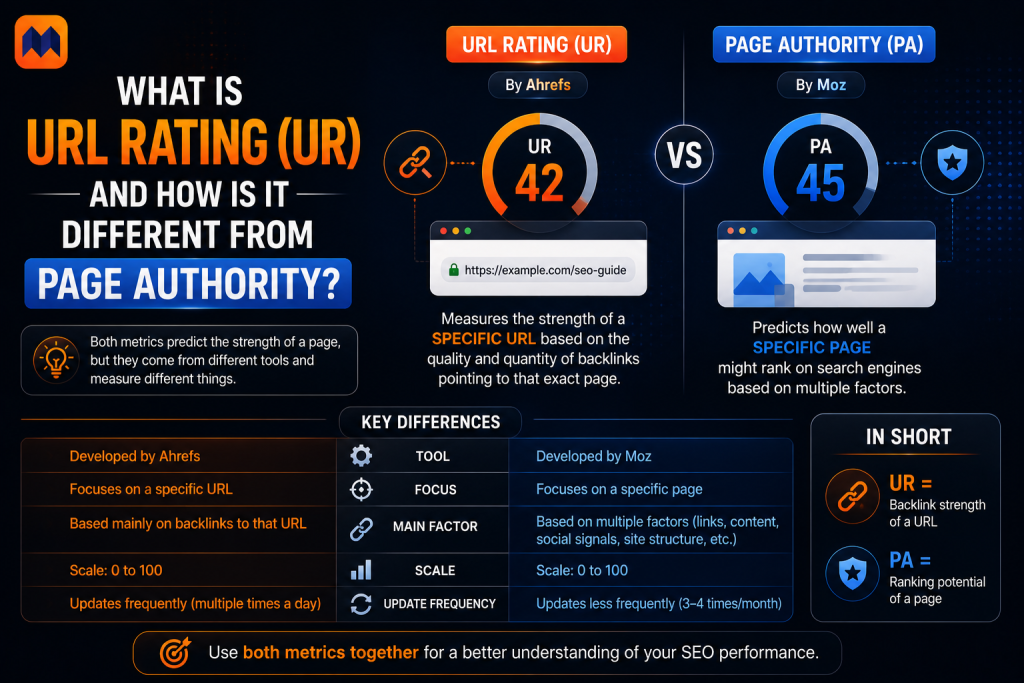
URL Rating is Ahrefs’ page-level authority metric. It scores the backlink strength of a specific URL on a logarithmic scale from 0 to 100 — the higher the score, the stronger the page’s link profile.
Ahrefs was explicit about what they built UR to approximate: it’s their version of Google’s original PageRank algorithm. Google used PageRank to evaluate how much authority a page carried based on the links pointing to it. Google stopped publicly displaying PageRank scores in 2016, but the underlying concept — that a page’s authority is determined by the links it receives and the authority of the pages doing the linking — still operates at the heart of how Google evaluates pages.
UR is Ahrefs’ attempt to replicate that signal using their own backlink index.
How UR is calculated:
UR accounts for both external backlinks (links from other domains pointing to that specific URL) and internal links (links from other pages on the same domain pointing to that URL). Both types contribute to the score, though Ahrefs weighs them differently. Only dofollow links pass UR — nofollow, sponsored, and UGC-tagged links are excluded from the calculation.
The quality of the linking page matters too. A link from an Ahrefs page with UR 80 contributes more to your page’s UR than a link from a page with UR 15. This mirrors PageRank logic: authority flows from strong pages to the pages they link to, proportionally.
One important note: Ahrefs updated their UR calculation algorithm in August 2022. The old model had documented weaknesses, and the revised version produces materially different scores. If you’re looking at UR data from before that date, the numbers won’t match current calculations — so any benchmark comparisons should use post-2022 data only.
Ahrefs updates UR frequently — often within days of their crawlers processing new backlinks — making it one of the most current page-level metrics available.
What Is Page Authority?
Page Authority is Moz’s page-level metric. Like UR, it runs on a logarithmic scale from 0 to 100 and measures how likely a given page is to rank in Google search results. Higher scores indicate stronger ranking potential.
Where UR is explicitly a PageRank approximation based on link data, PA goes a step further. Moz trains PA using machine learning models built on real search engine result data — meaning it’s calibrated against actual SERP outcomes, not just backlink signals. Moz founder Rand Fishkin once described PA as the model that DA is built on at the domain level, suggesting Moz treats it as their core authority calculation.
How PA is calculated:
PA is based primarily on backlink signals: the number of linking URLs, the number of linking root domains, the quality of those domains, and anchor text distribution patterns. But Moz incorporates additional undisclosed factors — dozens of them — into the model. Unlike Ahrefs, which publishes a fairly transparent description of how UR works, Moz hasn’t revealed the full PA formula.
What we know is that PA correlates with real ranking performance, not just raw link counts. A page with fewer but more relevant, higher-quality links can outperform a page with more links from weaker or less relevant sources.
PA updates on a slower cycle than UR — roughly monthly, aligned with Moz’s crawl index refresh. This means PA can lag behind real-world changes: a page that earns 20 new backlinks this week won’t see that reflected in its PA score until Moz’s next refresh cycle.
Where UR and PA Diverge
Both metrics are useful. Both are imperfect. The differences between them are specific enough to matter for real decisions.
Data source and index. Ahrefs and Moz operate entirely separate backlink crawlers. They discover and index different links, at different volumes, with different update frequencies. Ahrefs is widely considered to have the larger and more frequently updated index — which is part of why UR and PA scores for the same page rarely align. Neither is “correct.” They’re measuring the same concept with different rulers built from different data.
Internal links. UR explicitly accounts for internal links in its calculation. A page with strong internal linking from high-UR pages on the same domain will have a higher UR than a page with the same external backlinks but weak internal linking. PA’s treatment of internal links is less transparent. Moz hasn’t confirmed internal links contribute to PA in the same explicit way. This makes UR the more actionable metric for internal linking strategy — you can directly move UR scores by improving internal link structure, with measurable results.
What the score is measuring. UR is a pure link-strength signal: how strong is this page’s backlink profile, based on Ahrefs’ index? It doesn’t incorporate content quality, user engagement, or anything beyond links. PA incorporates backlink data through a machine learning model calibrated against actual rankings — which means it’s attempting to predict ranking likelihood, not just measure link strength. In theory, PA should be more holistic; in practice, the additional factors aren’t transparent enough to rely on directly.
Update speed. UR updates within days of new links being indexed by Ahrefs. PA updates monthly. For time-sensitive decisions — evaluating a link acquisition, monitoring competitor link building, tracking the effect of a link removal — UR gives you current data. PA gives you a monthly snapshot.
Tool availability. UR is only available through Ahrefs. You can’t cross-verify it in Moz, SEMrush, or anywhere else. PA is only available through Moz. For teams that use both tools, both metrics are available but represent separate data pipelines, not two views of the same data.
Side-by-Side: UR vs PA at a Glance
| Dimension | URL Rating (UR) | Page Authority (PA) |
| Created by | Ahrefs | Moz |
| What it measures | Page-level backlink strength | Page-level ranking potential |
| Scale | 0–100 logarithmic | 0–100 logarithmic |
| Internal links counted? | Yes — explicitly | Not confirmed |
| Nofollow links counted? | No — dofollow only | Not disclosed |
| Update frequency | Every few days | ~Monthly |
| Calculation method | PageRank-style algorithm, link data | Machine learning, trained on real SERPs |
| Tool exclusivity | Ahrefs only | Moz only |
| Last major update | August 2022 | Ongoing ML model updates |
| Best for | Real-time link analysis, UR improvement via internal linking | Holistic ranking prediction, Moz-based audits |
The Internal Linking Angle: Why UR Is Underestimated
Most SEOs know UR rises when they earn external backlinks. Far fewer appreciate that internal linking is a direct, controllable lever on UR — and this makes UR practically more actionable than PA.
Because Ahrefs explicitly factors internal links into UR, a high-UR page that links internally to a weaker page transfers a measurable portion of its UR to that destination. This is the same mechanism as external link equity transfer, applied within your own domain.
A DR 80 domain with a brand-new page that has zero internal links and no external backlinks will show a UR of 0–5 on that page — regardless of how strong the domain is overall. DR (domain-level authority) doesn’t flow down automatically to pages. Each page needs its own UR, built from the links pointing specifically to that URL.
This matters enormously for content strategy. When you publish a new article and link to it from three existing pages with UR 40–50, the new page starts with a UR meaningfully above zero — inheriting link equity from day one through internal links. Compare this to a page published with no internal links at all, which must wait for external backlinks before accumulating any UR.
PA doesn’t offer this same degree of direct manipulation. Its treatment of internal links isn’t confirmed, so you can’t design an internal link strategy around PA improvement with the same confidence. UR makes the internal linking → page authority relationship explicit and measurable.
Which Metric to Use — and When
Neither UR nor PA is universally superior. The right metric depends on what you’re trying to decide.
Use UR when:
- Evaluating a specific page’s link strength for competitor analysis in Ahrefs
- Measuring the impact of internal linking changes — UR updates quickly and reflects internal link shifts
- Checking how much authority a specific linking page will pass to yours (a link from a page with UR 55 vs UR 12 is a meaningful difference)
- Tracking link building progress in near-real time — UR reflects new backlinks within days
- Prioritising which of your own pages to build internal links from (link from your highest-UR pages to the pages you need to rank)
Use PA when:
- Working in a Moz-primary workflow or alongside Moz’s DA data for domain-level decisions
- Running a link audit using Moz’s Link Explorer, where PA provides consistent page-level context within the same data environment
- Making link prospecting decisions when your primary tool is Moz — PA gives you the page-level signal to complement DA
- Comparing authority across sites in a niche, using Moz’s data as a consistent benchmark
Use both together when:
- Prospecting link targets — checking both UR and PA flags discrepancies worth investigating. A page with UR 45 and PA 12 has strong links per Ahrefs but ranks poorly per Moz’s model, which is worth understanding before acquiring a link. A page with PA 35 and UR 9 suggests Moz’s model sees ranking signals beyond what Ahrefs is picking up from backlinks.
- Auditing your own site’s page-level authority — cross-referencing both gives a more complete picture than either alone.
Understanding the UR Score Benchmarks
Since UR is logarithmic, what a given score actually means in practice shifts significantly as you climb the scale.
- UR 0–15: New or largely unlinked pages. Common for fresh content with few or no external links and minimal internal link support. Competitive ranking potential is limited for most non-trivial keywords at this range.
- UR 16–30: Pages beginning to accumulate links. Typically competitive for low-difficulty keywords, particularly on established domains where internal link equity is flowing.
- UR 31–50: Solid page-level authority. Competitive for mid-difficulty queries. Pages in this range often appear consistently in top 10 results for their target keywords.
- UR 51–65: Strong authority. Typical of pages on well-established sites with meaningful backlink profiles. Top 3 positioning is realistic for many keywords in this range.
- UR 66–80: High authority. Usually requires a combination of strong external backlinks from high-DR domains and solid internal link support. Common on major publications and authoritative resource pages.
- UR 81–100: Exceptional authority. Top-tier publication landing pages, Wikipedia articles, major news outlets. Extremely difficult to achieve; the logarithmic scale means the gap between 80 and 90 is far larger than between 20 and 30.
Remember: these are contextual ranges. A UR 35 page on a niche site can outrank a UR 55 page if the content alignment, search intent match, and on-page signals are stronger. UR is a link-strength indicator, not a ranking guarantee.